
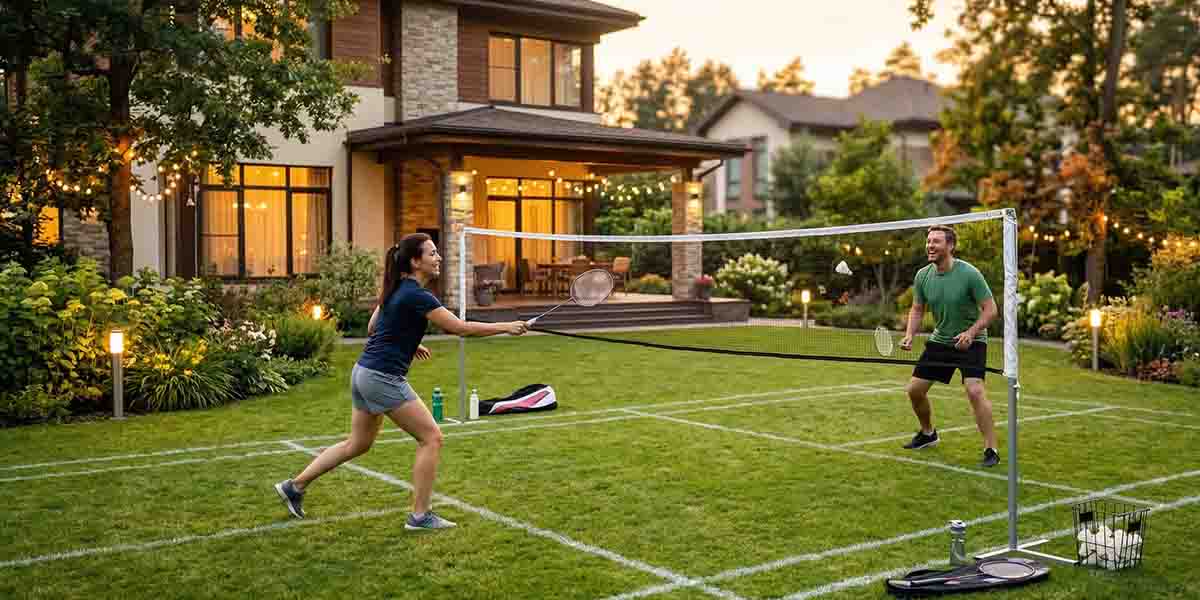
Badminton is one of the most enjoyable backyard sports you can play fast-paced, social, and suitable for all ages. Whether you want to practice your smashes or enjoy a casual game with family, setting up a dedicated court at home makes all the difference. This comprehensive guide walks you through everything you need to know, from measuring your space to stringing your net correctly.
1. Standard Badminton Court Dimensions
Before you purchase any equipment or start marking lines, it is essential to understand the official dimensions of a badminton court. These measurements follow the standards set by the Badminton World Federation (BWF) and ensure fair, enjoyable gameplay.
Official Court Dimensions
| Measurement | Singles | Doubles |
| Court Length | 13.4 m (44 ft) | 13.4 m (44 ft) |
| Court Width | 5.18 m (17 ft) | 6.1 m (20 ft) |
| Net Height (center) | 1.524 m (5 ft) | 1.524 m (5 ft) |
| Net Height (posts) | 1.55 m (5 ft 1 in) | 1.55 m (5 ft 1 in) |
| Service Line from Net | 1.98 m (6.5 ft) | 1.98 m (6.5 ft) |
| Back Boundary Line | 0.76 m (2.5 ft) | 0.76 m (2.5 ft) |
📌 Note: For a full recreational setup including clearance zones, plan for a space of at least 7 m x 16 m (23 ft x 52 ft). This safety buffer prevents players from colliding with fences, walls, or furniture.
2. Choosing the Right Location
Location is arguably the most important factor in creating a great backyard court. A poor location leads to bad gameplay and potential safety issues.
Key Factors to Consider
Surface Type
The surface beneath your court dramatically affects bounce, traction, and player safety. Here are the most common backyard options:
- Grass – Natural, soft underfoot, and easy to mark. However, it can become slippery when wet and may wear unevenly over time.
- Concrete or Asphalt – Durable and consistent. Best paired with anti-slip coatings or sport tiles. Can be hard on joints.
- Compacted Dirt or Gravel – Budget-friendly but inconsistent. Requires regular leveling and can cause bad bounces.
- Interlocking Sport Tiles – The gold standard for home courts. These polypropylene tiles are portable, weather-resistant, and provide excellent grip.
✅ Pro Tip: If installing on grass, keep the grass short (under 3 cm) and consider laying portable sport tiles for a more professional feel and consistent surface.
Orientation and Sun Position
Orient the court so that the long axis runs north-to-south. This prevents players from staring directly into the sun during morning or evening play, which can be both distracting and dangerous. Avoid placing the court directly under trees falling leaves and branches can interfere with play, and shade patterns can make the surface damp and slippery.
Wind Exposure
Badminton shuttlecocks (birdies) are extremely sensitive to wind. Choose a location sheltered from prevailing winds where possible. A fence, hedge, or wall on one or two sides can significantly reduce wind interference without obstructing natural light.
Clearance and Safety
Ensure there is adequate clearance around the court on all sides. The BWF recommends a minimum of 2 m (6.5 ft) of clear space beyond each sideline and 3 m (10 ft) behind each baseline for tournaments, though a 1 m buffer is acceptable for casual home play.
3. Equipment You Will Need
Setting up a proper backyard court does not require a massive investment. Here is a complete rundown of everything you need, broken into essential and optional categories.
Essential Equipment
| Item | Description | Approx. Cost (USD) |
| Badminton Net | Full-width net, 6.1 m wide, UV-resistant | $25 – $150 |
| Net Posts | Adjustable steel or aluminum, 1.55 m height | $30 – $200 |
| Line Marking Tape | Weather-resistant boundary tape or paint | $10 – $40 |
| Rackets | Set of 2–4 for recreational play | $20 – $150 |
| Shuttlecocks | Feather (tournament) or nylon (recreational) | $10 – $30/dozen |
| Measuring Tape | At least 15 m long for accurate court setup | $5 – $20 |
| Ground Stakes / Sandbags | To anchor net posts on grass or soil | $10 – $25 |
Optional but Recommended
- Sport Tiles or Court Mat – For a consistent playing surface
- Boundary Poles or Corner Markers – Visible boundary indicators
- Court Lights – LED spotlights allow evening play
- Scoreboard – Handy for tracking competitive games
- Equipment Storage Bag – Keeps rackets and shuttlecocks organized
4. Marking the Court Boundaries
Accurate court markings are essential for fair play and help all players agree on boundary calls. Take your time with this step — measurement errors early on will cause frustration during games.
Step-by-Step Marking Process
- Lay down your measuring tape along the longest available straight edge of your chosen area. Mark the centerline of your court with a temporary marker or chalk.
- From the center, measure 6.7 m (22 ft) in each direction along the length to mark the two baseline positions. Confirm total court length = 13.4 m (44 ft).
- At the net line (the center of the court lengthwise), measure 3.05 m (10 ft) in each direction to mark the doubles sidelines. For singles, the sidelines are at 2.59 m (8.5 ft) from center.
- Use a right-angle square or the 3-4-5 triangle method to ensure all corners are exactly 90 degrees. This is critical for fair boundary calls.
- Apply weather-resistant boundary tape or line paint along all marked positions. Press firmly to ensure adhesion, especially on hard surfaces.
- Mark the short service line 1.98 m (6.5 ft) from the net on each side. For doubles, also mark the long service line 0.76 m (2.5 ft) inside the baseline.
- Finally, mark the center service line running from the net to the short service line, dividing the service court in half.
✅ Pro Tip: Use brightly colored tape (yellow or white) for best visibility on grass. On concrete, opt for court marking paint, which lasts much longer than tape.
5. Installing the Net and Posts
The net is the heart of your badminton court setup. Incorrect net height or tension is a common mistake that affects gameplay significantly.
Post Placement
Net posts should be placed on the doubles sidelines, directly on the net line. They must be vertical and firmly anchored. For grass surfaces, drive the post stakes at least 30 cm (12 inches) into the ground. On hard surfaces, use weighted bases or sandbag stands designed for portable court use.
Attaching and Tensioning the Net
- Unroll the net and attach one end to the first post, starting at the top loop.
- Walk the net across to the second post and attach it, keeping the net as straight as possible.
- Use the provided cord or rope to thread through the top of the net and tie it taut between the posts. The net should sit at 1.55 m (5 ft 1 in) at the posts.
- Check the center of the net with a measuring tape — it should dip slightly to 1.524 m (5 ft) at the midpoint. Use a center strap if your net includes one.
- Verify that the bottom of the net is taut and sits close to the court surface with minimal gap. A gap larger than 5 cm can allow shuttlecocks to slip underneath.
📌 Note: The official net height at the center is 1.524 m (5 ft) and 1.55 m (5 ft 1 in) at the posts. This slight curve is intentional and part of the official BWF specifications.
6. Surface Preparation Tips
A well-prepared surface extends the life of your markings and equipment, and keeps players safe.
For Grass Courts
- Mow grass to 2–3 cm height before play and regularly throughout the season.
- Check for uneven patches, holes, or debris before each session.
- After wet weather, allow the surface to dry before playing to reduce slip risk.
- Consider applying a light layer of sand to low-lying areas to improve drainage.
For Hard Surfaces (Concrete/Asphalt)
- Apply an anti-slip coating or rubber mat strips in areas of high movement.
- Fill any cracks or depressions with surface filler to prevent tripping hazards.
- Install cushioned sport tiles over hard concrete if players experience joint discomfort.
For Sport Tiles
- Lay tiles with edges interlocked tightly and confirm no tile edges are raised.
- Use border/ramp tiles at the perimeter to eliminate tripping ledges.
- Periodically check and relock any tiles that shift over time.
7. Choosing the Right Shuttlecocks and Rackets
Even a perfectly set-up court is only as good as the equipment you use. Here is how to choose wisely for backyard play.
Shuttlecocks
| Type | Best For | Durability | Flight Quality |
| Feather (Goose) | Advanced/competitive players | Low (fragile) | Excellent |
| Feather (Duck) | Intermediate players | Medium | Very Good |
| Nylon/Plastic | Beginners & recreational | High | Good (wind-affected) |
| Hybrid | All-rounder | Medium-High | Very Good |
For backyard play, especially for beginners or in windy conditions, nylon shuttlecocks are highly recommended. They are more durable, less affected by humidity, and significantly more affordable than feather alternatives.
Rackets
Rackets come in three weight categories – Light (< 85g), Medium (85–89g), and Heavy (> 90g). For recreational backyard play, a medium-weight all-round racket in the 85–89g range works best for most players. Look for:
- A flexible shaft for beginners – easier to generate power
- A medium-balance point for versatile play
- A grip size that matches your hand (G4 or G5 are most common)
- A durable string tension of 20–24 lbs for casual play
8. Lighting for Evening Play
Adding lights to your backyard court unlocks evening play and dramatically extends how much time you spend using your court. Here is what to consider:
Lighting Placement
Position lights at the four corners of the court, angled inward and slightly downward to illuminate the playing surface evenly. Avoid placing lights directly above the net — shuttlecocks flying high against bright overhead lights become very difficult to track. LED floodlights mounted on 3–4 m poles at each corner are the most effective setup.
Recommended Specifications
- Luminance: Minimum 200 lux for recreational play, 300+ lux for competitive
- Color Temperature: 4000–5000 K (neutral to cool white) for best visibility
- Beam Angle: 60–90 degrees to minimize glare while covering the full court
- IP Rating: IP65 or higher for weather resistance
✅ Pro Tip: Solar-powered LED floodlights are an eco-friendly and cost-effective option for backyard courts. Look for models with a built-in dusk-to-dawn sensor for hands-free operation.
9. Maintenance and Care
A little maintenance goes a long way in keeping your court in top condition season after season.
Regular Maintenance Checklist
- Check net tension and height before each play session
- Inspect boundary tape or paint for peeling or fading — touch up as needed
- Clean court surface of leaves, debris, and standing water after rain
- Inspect post anchors for looseness, especially after strong winds or heavy rain
- Store shuttlecocks in a humidity-controlled tube or case to extend their life
- Restring rackets every 3–6 months if playing regularly, or when strings feel loose
Seasonal Storage
If you live in an area with harsh winters, it is best to dismantle portable components and store them indoors. Most net posts and nets are not designed for prolonged exposure to ice and snow. Marking tape should be removed from grass to prevent dead patches. Sport tiles can usually remain outdoors if temperatures do not fall below -20°C (-4°F).
10. Quick Setup Summary Checklist
Use this checklist to confirm your court is fully ready for play:
| Step | Task | Done? |
| 1 | Measured and confirmed minimum 7 m x 16 m space available | ☐ |
| 2 | Chosen suitable surface and prepared it accordingly | ☐ |
| 3 | Purchased all essential equipment (net, posts, tape, rackets, shuttles) | ☐ |
| 4 | Marked all court boundary lines accurately with tape or paint | ☐ |
| 5 | Installed net posts vertically and firmly anchored | ☐ |
| 6 | Attached net and verified height: 1.55 m at posts, 1.524 m at center | ☐ |
| 7 | Checked all line markings: baselines, service lines, center line | ☐ |
| 8 | Confirmed safety clearance on all sides of the court | ☐ |
| 9 | Installed lighting if evening play is planned | ☐ |
| 10 | Equipment stored properly between sessions | ☐ |
Conclusion
Setting up a backyard badminton court is a rewarding project that pays dividends in fun, fitness, and family time for years to come. By following the measurements, surface tips, and equipment guidelines in this guide, you will have a court that is not only enjoyable to play on but one you can be proud of. Whether you are setting up a casual grass court for weekend rallies or installing permanent sport tiles with proper lighting for competitive matches, the investment is well worth it.
Now grab your racket, find a partner, and enjoy the game!
Add comment