
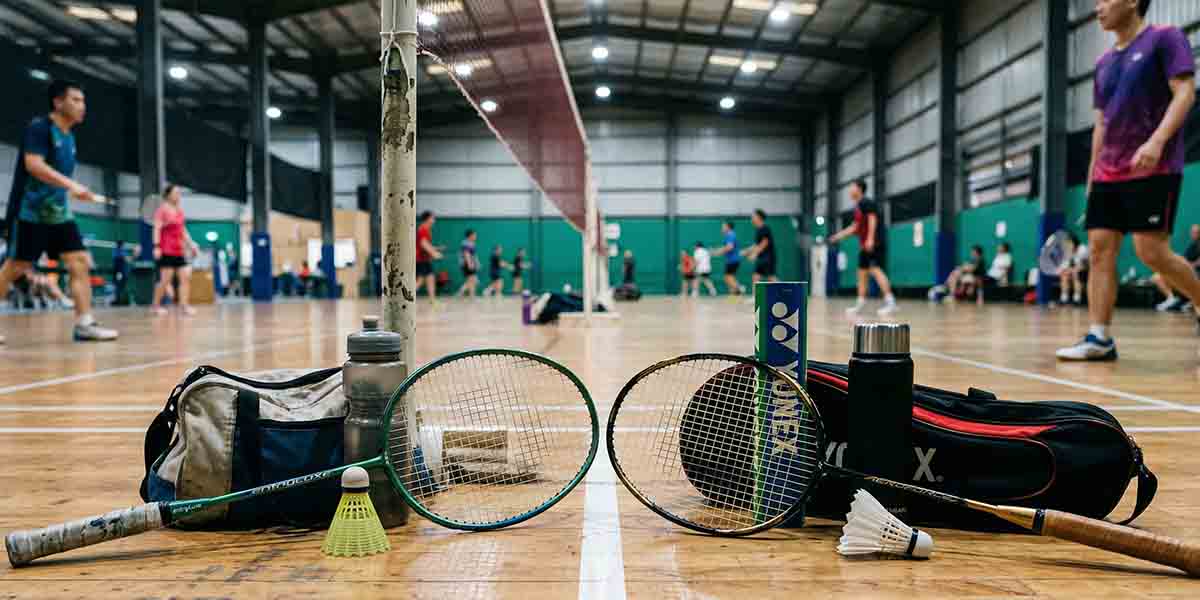
Walk into any sports store and the range of badminton gear on display will either excite you or give you a mild headache. A beginner racket can cost as little as 300 rupees. A professional-grade one can set you back 15,000 rupees or more. The shuttlecocks, the shoes, the strings, the grips — it all adds up fast, and the question most players eventually ask is a reasonable one: does expensive gear actually matter, or is it just marketing dressed up in carbon fiber?
The honest answer is: it depends. It depends on your skill level, how often you play, what surface you play on, and what you are trying to get out of the game. This article breaks it all down, piece by piece, so you can make a smart buying decision rather than simply reaching for the flashiest option on the shelf.
The Racket: Where the Biggest Differences Live
Of all the gear you will buy, the racket is where price differences are most noticeable in actual play. That is not just marketing talk — the materials used, the weight distribution, and the frame construction genuinely change how the racket behaves in your hand.
Budget Rackets (Under ₹1,500)
Entry-level rackets are typically made from aluminum or low-grade steel. They are heavier, less aerodynamic, and offer almost no flexibility control. You will usually find them sold as sets with two rackets and a few shuttles, which tells you everything about how seriously the manufacturer takes individual performance.
For absolute beginners who are not sure whether they even enjoy the sport, this range makes sense. You are not wasting money if you decide badminton is not for you. But if you find yourself playing twice a week and wanting to improve, you will quickly hit the ceiling of what these rackets allow you to do. The heavy frame makes quick net play difficult, and the string tension is usually pre-set at a level that provides little control.
Mid-Range Rackets (₹1,500 to ₹6,000)
This is where things start to get genuinely interesting. In this price bracket, you start seeing graphite or carbon graphite frames, which reduces weight considerably. A racket that weighs 85 grams instead of 95 grams might not sound like a big deal, but during a 45-minute singles match, that 10-gram difference across hundreds of swings becomes very noticeable in your arm.
Brands like Yonex, Li-Ning, and Victor offer solid club-level rackets in this range. You get better string bed quality, more consistent flex, and the ability to actually choose whether you want a head-heavy racket for power or a balanced one for control. For recreational players who play regularly and want to improve, this range offers the best value on the market.
Premium Rackets (₹6,000 to ₹20,000+)
Professional and advanced recreational rackets in this bracket are made from high-modulus graphite, sometimes with nano-carbon reinforcement or proprietary materials. The manufacturing tolerances are tighter, the aerodynamics are engineered rather than approximated, and the flex profile is carefully calibrated to suit specific playing styles.
The Yonex Astrox and Duora series, or Victor’s Thruster and Jetspeed lines, sit in this category. A well-made racket here will genuinely improve shot quality for an advanced player. The repulsion speed is higher, the vibration dampening is better, and the frame stiffness allows for more precise string tension customization.
That said, putting a 15,000-rupee racket in the hands of someone who has only been playing for six months will not transform their game. Expensive rackets are tools for players who already have the technique to use them. A beginner without a proper backhand swing will not notice the aerodynamic improvements — they will just have a lighter, very expensive racket that they still cannot use properly.
| 🎯 What Are You Looking For? | 👉 See Top Picks from Amazon |
|---|---|
| New to badminton? | ⭐ Best Beginner Rackets |
| Want powerful smashes? | ⭐ Best Head Heavy Rackets |
| Play aggressively? | Best Attacking Rackets |
| Prefer ultra-light rackets? | Best Lightweight Yonex Rackets |
| Curious what pros use? | Professional Players’ Rackets |
| Want premium gear? | Most Expensive Badminton Rackets |
| Loyal to Yonex Voltric? | Best Yonex Voltric Series |
Strings: The Most Underrated Purchase in Badminton
Most recreational players spend 8,000 rupees on a racket and then leave whatever factory strings came with it for the next two years. This is one of the biggest mistakes you can make. The string is the only part of your racket that actually contacts the shuttle. Everything else is just a delivery system.
Cheap Strings
Factory strings on budget rackets are typically nylon-based and pre-strung at low tensions, often around 18 to 20 pounds. This makes them durable and beginner-friendly in the sense that they do not snap easily. But they also absorb energy rather than return it, meaning your clears and smashes feel flat even when you hit them cleanly.
Mid-Range Strings (₹400 to ₹900 per set)
Strings like the Yonex BG65 have been a club standard for decades for a reason. They offer a good balance of durability and feel, and when strung at 24 to 26 pounds, they give you the kind of feedback that helps you know when you are hitting the shuttle correctly. For most club-level players, this is the sweet spot.
Premium Strings (₹900 to ₹2,500 per set)
High-end strings like the Yonex BG80 or Victor VBS-70 Power are noticeably thinner and deliver exceptional repulsion. They snap more easily and do not last as long, but for a competitive player, they provide a sharper feel and better shuttle response. If you are playing in tournaments or training seriously, the difference is real. If you play twice a week socially, you are better off spending your money on re-stringing a mid-range string more regularly.
Shuttlecocks: Feather vs Nylon
The shuttlecock question tends to divide players more than almost anything else. Feather shuttles fly beautifully and decay quickly. Nylon shuttles last forever but fly differently. This is not a case where expensive is always better — it is a case where context determines the right choice.
Nylon Shuttles (₹100 to ₹500 per tube)
A good quality nylon shuttle — the Yonex Mavis series is the benchmark — will last many sessions and is not significantly affected by humidity or altitude. The flight trajectory is slightly different from feather, particularly at the net where drops feel a little less precise. But for training, casual play, and outdoor courts, nylon makes complete practical sense. You are not going to use expensive feather shuttles in a windy park.
Feather Shuttles (₹600 to ₹1,800 per tube)
Feather shuttles, made from duck or goose feathers, offer a flight path that nylon simply cannot match. The deceleration after a smash is sharper, the net play is more precise, and the overall feel of the game is elevated. Competitive players and serious club players almost universally prefer them for match play.
The drawback is obvious: feathers break. In a hard-hitting game, you might go through a tube of six shuttles in a session. That cost adds up quickly. For most recreational players, the honest recommendation is to use nylon for practice and save feathers for match days or when you specifically want to train with realistic shuttle behavior.
Shoes: Do Not Cut Corners Here
Of all the gear in badminton, shoes are the one area where spending more is genuinely justified, regardless of your skill level. The nature of the sport — constant lateral movement, sudden stops, explosive jumps — puts serious stress on your ankles and knees. The wrong footwear is not just a performance issue. It is a health issue.
Running or Generic Sneakers
A lot of casual players use running shoes or general gym shoes on court. Running shoes are designed for forward motion — they provide cushioning along the heel-to-toe axis. Badminton requires constant side-to-side movement, and running shoes offer very little lateral support. Playing regularly in running shoes significantly increases the risk of ankle sprains and knee problems over time.
Budget Court Shoes (₹1,200 to ₹3,000)
Entry-level badminton-specific shoes from brands like Li-Ning, Victor, or even ASICS Gel-Rocket offer far better lateral support than running shoes. The soles are gum-rubber based, providing grip on wooden or synthetic indoor courts. They are not as well-cushioned as premium options, and the upper materials tend to wear out faster, but they are a substantial upgrade over cross-training shoes for someone playing two or three times a week.
Premium Court Shoes (₹4,000 to ₹12,000)
High-end badminton shoes from Yonex Power Cushion series, Victor A970, or ASICS Gel-Blade offer engineering specifically designed for the demands of court sports. The midsole cushioning technology absorbs impact forces that accumulate over a long training session, the lateral reinforcement prevents excessive ankle roll, and the outsole pattern is optimized for the quick pivot-and-push movements that badminton requires.
If you have any history of knee or ankle issues, this is where to invest your money first — before the racket, before the strings. A player with good shoes and a mid-range racket will enjoy the game more and stay injury-free longer than someone with a top-of-the-range racket and cheap footwear.
Grip: The Cheapest Upgrade You Can Make
The grip tape on your racket handle is almost always overlooked, but it is one of the most cost-effective improvements you can make. A worn-out or poorly suited grip reduces your control and can cause you to squeeze the handle too tightly, which leads to arm fatigue and tennis elbow over time.
Replacement grips from Yonex (AC102 or Super Grap) cost anywhere from 80 to 300 rupees and take under five minutes to apply. Toweling grips absorb sweat well and are preferred by many players in humid climates. Synthetic grips are thinner and provide a crisper feel for players who prefer a direct connection to the handle. Neither is objectively better — it is a personal preference.
If your grip feels slippery or dead, replace it. A fresh grip on a mid-range racket can actually feel better in the hand than a worn grip on an expensive one. This is one of the lowest-cost, highest-impact maintenance steps that most recreational players simply do not bother with.
Bags: Function Over Fashion
Badminton bags range from 500-rupee drawstring pouches to 8,000-rupee tournament bags with thermal compartments for temperature-sensitive strings. For most players, the honest advice is simple: buy a bag with enough compartments to separate your shoes from your gear, and make sure it can hold at least two rackets comfortably. The Yonex and Victor entry-level bags in the 1,000 to 2,500 rupee range do this perfectly well.
The thermal compartment bags are a genuine benefit in very hot climates where strings can warp or in cold climates where they can stiffen. If you play outdoor tournaments in summer, that feature earns its cost. For someone going to an air-conditioned indoor hall twice a week, it is overkill.
Matching Gear to Skill Level: A Practical Framework
The gear industry benefits when players buy expensive equipment before they are ready for it. The truth is that the returns on expensive gear are not linear — they scale with skill level. Here is a rough framework for thinking about what to spend at each stage:
Complete Beginners (Playing less than 6 months)
- Racket: Mid-range graphite (₹1,500 to ₹3,000). Avoid starter sets.
- Shoes: Budget court shoes (₹1,500+). Do not play in running shoes.
- Shuttles: Nylon for most sessions.
- Strings: Leave factory strings for now.
Intermediate Club Players (Playing 1 to 3 years)
- Racket: Good graphite racket (₹3,000 to ₹7,000). Choose based on style (power vs control).
- Shoes: Mid-range court shoes (₹3,000 to ₹5,000).
- Strings: Get professionally strung with BG65 or equivalent at 24 to 26 lbs.
- Shuttles: Mix of nylon (practice) and feather (match play).
Advanced and Competitive Players
- Racket: Premium graphite (₹7,000 to ₹15,000). Choose a model suited to your game.
- Shoes: Premium court shoes (₹5,000+). Non-negotiable at this level.
- Strings: High-performance strings at appropriate tension. Restring every 3 to 4 weeks.
- Shuttles: Feather for all serious practice and matches.
Brand Loyalty vs Smart Shopping
Yonex dominates badminton in terms of brand recognition, and for good reason — their quality control is consistent, their technology is genuinely good, and their products hold resale value. But treating Yonex as the only option is limiting. Victor, Li-Ning, and Apacs produce rackets that match or exceed Yonex quality in specific categories, often at a lower price point.
Victor rackets, for instance, have strong reputations in the power category and are official sponsors of several top-ranked players. Li-Ning has invested heavily in Chinese market technology and offers excellent value, particularly in the mid-range. The brand on the frame matters less than the specs that suit your style of play.
Also worth noting: fake rackets are a serious problem in the Indian market. A racket purchased from a roadside shop for 600 rupees claiming to be a Yonex Voltric 80 is a fake, and it will play nothing like the real thing. If you are buying branded gear, stick to authorized dealers or reputable online stores with return policies.
The Second-Hand Market: Hidden Value
One option that many players overlook is the second-hand market. A lightly used premium racket bought through a badminton community group for 3,000 rupees can outperform a brand-new mid-range racket at 4,000 rupees. The caveat is that you need to know what to look for — check the frame for cracks (especially around the throat and top of the head), make sure the grommet holes are not damaged, and always plan to restring before playing.
Clubs and university badminton communities often have players who upgrade their equipment regularly and sell old gear at fair prices. This is a genuinely underutilized resource for intermediate players looking to move up in gear quality without the full retail price.
The Bottom Line
Expensive gear does not make you a better player. But the right gear — matched to your skill level and how you play — absolutely helps. The key is knowing what matters most at each stage of your development.
Shoes matter at every level. Prioritize them first. Strings matter more than most players realize, and a mid-range racket that is properly strung will outperform an expensive one with dead factory strings every single time. Shuttlecocks depend on context — do not waste feathers in a windy park. And the racket itself becomes a meaningful investment only once your technique is developed enough to notice the difference.
Spend smartly. Buy the gear that removes friction from your game at your current level, not the gear that elite players use on television. You can always upgrade when you grow into it.
| 🏸 Need Better Comfort & Performance? | 👉 Explore Top Picks from Amazon |
|---|---|
| Want better grip on court? | ⭐ Best Non-Marking Badminton Shoes |
| Just starting out? | Best Beginner Badminton Shoes |
| Carry gear like a pro? | Best Badminton Bags |
| Confused about string tension? | Best String Tension Guide + Top Strings |
| Need an all-in-one starter kit? | Portable Badminton Racket Sets |
| Protect your eyes during fast rallies? | Best Badminton Glasses |
| Upgrade your court style? | Comfortable Badminton Outfits |



Add comment