
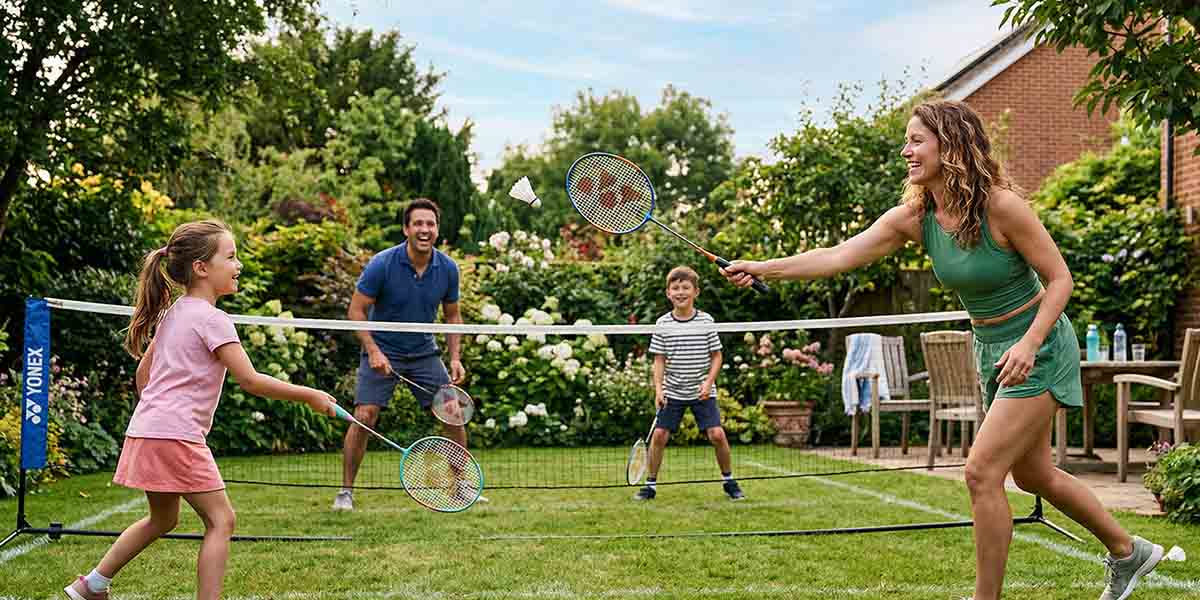
There is something about a badminton rally in the backyard or on the beach that brings everyone together. Kids put down their phones, parents rediscover a sport they played in school, and grandparents join in with surprising confidence. Badminton is one of those rare games that genuinely works across generations — it does not demand extraordinary fitness, it is easy to learn, and a good set can last for years with basic care.
Yet walking into a sporting goods store or scrolling through an online marketplace, you will quickly find yourself staring at dozens of options — sets priced anywhere from a few hundred rupees to several thousand, with descriptions full of terms like “high-modulus carbon,” “ISO-standard net,” and “feather vs. nylon shuttle.” Knowing what actually matters for a family set versus what is just marketing language saves both money and frustration.
This guide covers everything worth knowing: what a complete set should include, how to pick rackets that suit players of different ages, which shuttlecocks hold up in outdoor conditions, how to set up a proper net, and which brands have proven themselves over the years. By the end, you should have a clear picture of what to buy and what to skip.
What Comes in a Family Badminton Set
A family badminton set is essentially a packaged bundle that gives you everything needed to play without sourcing individual components separately. Most sets sold for recreational and family use include the following:
- Rackets — usually two to four, sometimes with different grip sizes for younger players
- Shuttlecocks — commonly three to six, either nylon or feather
- A net — either freestanding with poles or a simple tie-between-posts style
- A carrying bag or storage case
Some premium sets add boundary lines, a pump for shuttlecock tubes, extra grip tape, and even a scorekeeper. For a family that plays a few times a week, the basic bundle is usually sufficient, though checking the net quality before purchasing is worth the effort since it is often where manufacturers cut corners on cheaper sets.
| 🎯 What Are You Looking For? | 👉 See Top Picks from Amazon |
|---|---|
| New to badminton? | ⭐ Best Beginner Rackets |
| Want powerful smashes? | ⭐ Best Head Heavy Rackets |
| Play aggressively? | Best Attacking Rackets |
| Prefer ultra-light rackets? | Best Lightweight Yonex Rackets |
| Curious what pros use? | Professional Players’ Rackets |
| Want premium gear? | Most Expensive Badminton Rackets |
| Loyal to Yonex Voltric? | Best Yonex Voltric Series |
Choosing the Right Rackets
Rackets are the most personal component of any badminton set. Picking the wrong ones — too heavy, too stiff, or with a grip that does not fit the player’s hand — leads to fatigue and poor control. Here is what to consider:
Weight
Badminton rackets are categorized by weight with a system most manufacturers follow: U3 (about 85–89 grams), U4 (80–84 grams), and 5U or 6U (72–79 grams). For family use, a 3U or 4U racket is the sweet spot. Lighter rackets suit beginners because they are easier to swing and generate speed without tiring the wrist, but they need enough mass to feel stable during exchanges. Very light rackets in the sub-70g range are for advanced players who generate their own power and do not need help from the frame.
For children under twelve, look for rackets specifically labelled as junior sizes — these are shorter (around 620mm compared to the standard 665mm) and lighter, which makes it much easier for small players to develop proper technique rather than just muscling the shuttle over the net.
Frame Material
Family sets come with two main types of frame material: steel/aluminum alloy and carbon fiber (sometimes called graphite). Steel or aluminum frames are heavier and less responsive but also much cheaper and more resistant to the accidental drops and scrapes that come with family use. They are perfectly adequate for casual backyard games.
Carbon fiber frames are lighter, stiffer, and transmit more shuttle feel to the player’s hand. Sets with carbon frames cost more but offer noticeably better performance. If your family plays regularly or has a teenager who is picking up the sport seriously, spending a bit more for carbon-shaft rackets is a worthwhile investment.
Grip Size and Material
The grip is what connects the player to the racket, and getting this right matters more than most buyers realize. Grips are typically sized G4 or G5, with G5 being thinner. Adults with larger hands generally prefer G4, while women, teenagers, and children often find G5 more comfortable.
The grip material itself wears out with use. Toweling grips absorb sweat well and feel soft but tend to deteriorate faster in humid conditions. Synthetic PU grips are more durable and hold up outdoors. Replacement grips cost almost nothing and take a minute to apply, so do not let a worn grip put you off an otherwise good racket.
Shuttlecocks: Feather or Nylon?
Few decisions in badminton spark more debate among casual players than the choice between feather and nylon shuttlecocks. Both have genuine advantages, and the right choice depends on where you play and how serious your game is.
Feather Shuttlecocks
Feather shuttlecocks — made from sixteen goose or duck feathers attached to a cork base — are the standard for competitive play at every level. The flight they produce is uniquely consistent: they decelerate rapidly at the top of their arc and then drop at a steep angle, which rewards skillful net play and deceptive drops. Serious players often describe nylon shuttles as feeling plastic and predictable by comparison.
The drawbacks for family use are real, though. Feather shuttles are fragile — a powerful smash or a misjudged hit against the net can bend or snap feathers, and a single shuttle rarely survives more than one or two sessions of vigorous play. They are also sensitive to temperature and humidity: shuttles meant for cool air travel faster than those designed for hot and humid conditions, and most manufacturers print a speed grade on the tube. Buying the wrong speed grade for your environment leads to shuttles that consistently fall short of or fly past the baseline.
Nylon Shuttlecocks
Nylon shuttlecocks, sometimes called plastic shuttles, are made with a synthetic skirt attached to either a cork or rubber base. They are far more durable — a good nylon shuttle can last dozens of sessions even when played outdoors on concrete or hard ground. They resist humidity and temperature changes, which makes them the practical choice for backyard and beach play.
The flight does differ from feather: nylon shuttles tend to fly a bit flatter and are slightly more predictable in their trajectory, which is actually an advantage for beginners learning to time their shots. The gap in feel between feather and nylon has narrowed considerably with better manufacturing — mid-range nylon shuttles from brands like Yonex, Victor, and Li-Ning now offer very respectable performance for recreational play.
For most families, nylon is the sensible starting point. Once players develop enough skill to appreciate the nuances of feather flight, a tube of feather shuttles for indoor sessions becomes a worthwhile addition.
Setting Up Your Net Properly
The net is the component most often overlooked in budget family sets, and it shows. A saggy, uneven net that collapses in a mild breeze ruins the game faster than almost anything else. Understanding the basics of net setup and what to look for prevents a lot of frustration.
Standard Dimensions
According to the Badminton World Federation’s regulations, the net should be 1.55 meters high at the poles and 1.524 meters (approximately five feet) at the center. For family play you do not need to be exact, but being close to these measurements preserves the essential character of the game. A net set too low turns every exchange into a smash contest; too high and the game becomes exhausting.
The full width of a doubles court is 6.1 meters, but for backyard play most families use whatever space they have. A half-width singles game on a 5.18-meter court is perfectly enjoyable and requires less ground.
Freestanding vs. Post Systems
Family sets come with two types of net systems. Freestanding systems include weighted base poles that can be set up anywhere — on grass, sand, concrete, or a driveway — without needing to anchor anything to the ground. They are convenient and portable but can shift during play if the bases are not heavy enough.
Post systems require driving stakes into the ground or using tension ropes. They are more stable but limit you to soft ground and take longer to set up. For families who play at the same spot consistently — in a garden, for example — a well-anchored post system is more stable. For families who move between locations, a freestanding system with heavier bases is the better compromise.
Net Quality Indicators
Check whether the net has a reinforced top tape (a white band running along the top edge). This tape prevents the net from stretching and keeps the top edge taut and visible. A good net should also have its mesh spaced tightly enough — typically 20mm squares or smaller — so that shuttles do not pass through or catch in the mesh.
Indoor vs. Outdoor Play
Badminton was designed as an indoor sport, and the physics of the game — particularly the sensitivity of the shuttle to air movement — reflect that origin. Playing outdoors introduces challenges that are worth thinking through before setting up your court.
Wind and the Shuttle
Even a light breeze of five to ten kilometers per hour can push a shuttle several meters off course, turning a straight drive into a wild miss. This is not necessarily a problem for a relaxed family knockabout — many players enjoy adapting to wind as an extra challenge — but it does mean that competitive scoring is difficult outdoors.
If you regularly play in breezy conditions, choosing heavier nylon shuttles or ones specifically marketed as outdoor shuttles helps. Some manufacturers produce shuttles with modified skirt designs that are less sensitive to crosswinds. The shuttle will still move in wind, but the game remains more manageable.
Surface Considerations
Badminton is typically played on a smooth, non-slip surface — wooden gymnasium floors, rubber sports flooring, or packed synthetic turf. Grass is workable for casual play but slows footwork significantly and can be uneven. Concrete and paving surfaces are hard on joints during longer sessions, so quality footwear matters more on hard ground than on grass.
One thing worth noting: if you or your children play regularly outdoors on a hard surface, investing in badminton-specific shoes rather than general trainers reduces the risk of ankle rolls and knee stress. The lateral movement in badminton differs from running, and purpose-built shoes are designed to handle it.
Popular Brands and What They Offer
The market for family badminton sets is crowded, but a few brands consistently deliver better quality than the rest. Here is a practical overview of what each major brand brings to the table.
Yonex
Yonex is the most recognized name in badminton globally, and for good reason — the Japanese brand has supplied equipment for top professional tournaments for decades. Their family sets are reliable, well-built, and designed with genuine technical understanding rather than just cosmetic branding. Even their entry-level sets use decent materials. The downside is that Yonex charges a premium, and some of the value is in the brand name rather than the equipment itself at the lower price tiers. Their Carbonex and GR series rackets offer good entry points for families.
Victor
The Taiwanese brand Victor has carved out a strong reputation as the quality alternative to Yonex, often at a lower price. Their family sets and recreational rackets are well-regarded in South and Southeast Asia, where badminton culture is deeply embedded. Victor rackets in the mid-range tend to offer better value per rupee or ringgit than equivalent Yonex models. Their shuttlecocks, both feather and nylon, are trusted by club players and competitive junior players alike.
Li-Ning
Li-Ning, the Chinese sportswear giant, has made significant inroads in badminton equipment over the past decade, partly through high-profile sponsorships of top-ranked players. Their family sets are competitively priced and have improved considerably in quality. For buyers in India, Li-Ning has established a strong distribution network, making their sets easy to find and service. Their Windstorm and G-Force entry series are worth considering for families buying their first set.
Cosco and Other Budget Brands
For buyers on a tighter budget, Indian brands like Cosco and Silver’s offer complete sets at accessible prices. The quality is noticeably lower than the premium brands — frames flex more, nets tend to sag sooner, and shuttlecocks wear faster — but for a family playing once a week in the garden, these sets can last a reasonable amount of time. They are a sensible starting point for younger children who may outgrow the sport before justifying a larger investment.
Maintaining Your Badminton Set
A good badminton set lasts much longer with a little care. None of this requires much effort, but neglecting the basics shortens the life of every component.
Racket Care
Keep rackets in their covers when not in use. Direct sunlight weakens the resin in carbon frames over time, and even aluminum frames can warp if left in a hot car or shed. Do not lean rackets against walls for extended periods — the frames can develop a slight curve that affects performance.
Check the strings periodically if your rackets come pre-strung. Most family-set rackets arrive strung at 18 to 22 pounds of tension, which is on the lower end of the professional range and appropriate for casual play. Strings eventually lose tension and go “dead,” making the racket feel sluggish. Re-stringing at a local sports shop costs between 300 and 600 rupees for most rackets and transforms the feel completely.
Shuttlecock Storage
Nylon shuttles need very little care — store them in their original tube or a dry container and they remain usable for months. Feather shuttles are more delicate. The traditional advice is to store them in a cool, moderately humid environment. Some players dampen the feathers slightly before play by briefly exposing the open end of the tube to steam, which makes the feathers more flexible and extends their life. Avoid leaving feather shuttles in direct sunlight or in excessively dry conditions, as brittle feathers snap far more easily.
Net and Poles
Rinse net poles with fresh water after beach play to prevent saltwater corrosion, particularly on the joints and adjustment mechanisms. Roll the net loosely rather than folding it — tight folds create permanent creases in the mesh that weaken the fibers over time. Store metal poles away from moisture to prevent rust on the joints.
Teaching Children to Play
Badminton is one of the more accessible sports for children partly because the shuttle moves slowly enough at the beginner level to give young players time to react, and partly because rallies can develop even between mismatched skill levels. That said, a few coaching principles from the start prevent the development of habits that become problems later.
Starting with the Grip
The most common mistake young players make is holding the racket like a frying pan — with the strings facing upward and the thumb flat against the handle. This limits their ability to rotate the racket for backhand shots and puts unnecessary strain on the wrist. The correct forehand grip has the thumb resting diagonally across the back of the handle, with the fingers wrapped naturally around it as if you were shaking someone’s hand.
Spend five minutes on grip before the first game. Children are generally happy to adjust early on; convincing a teenager to change an ingrained grip is considerably harder.
Basic Footwork
Badminton is as much a footwork sport as it is a racket sport. The “ready position” — knees slightly bent, weight on the balls of the feet, racket held at roughly chest height — allows quick movement in any direction. Encourage children to return to the center of their half of the court after each shot. This habit becomes the foundation of all strategic court coverage as they develop.
Keeping It Fun
At the family level, the goal is participation and enjoyment rather than perfect technique. Short rallies are fine. Inventing variations of the game — trying to keep the shuttle in the air for as long as possible, or playing cooperative rather than competitive rounds — maintains interest for younger children who may find strict scoring discouraging. Once the basics feel natural, competitive play develops organically.
Price Guide and What to Expect at Each Level
Understanding what price range buys what level of quality helps set realistic expectations. The following breakdown is a general guide based on the Indian market; prices in other countries will differ but the relative comparisons hold.
Under ₹1,000
At this price, expect steel or heavy aluminum rackets, a basic nylon-cord net with thin poles, and a small tube of nylon shuttles. These sets work for occasional use — a picnic, a holiday trip, or introducing very young children to the game. The rackets will flex noticeably on impact, the net will likely sag within a few sessions, and the shuttles may develop cracks quickly. Consider these truly disposable or introductory.
₹1,000 to ₹3,000
This mid-range covers the majority of family set purchases. Aluminum alloy frames become noticeably better in this range, and some sets begin to include carbon-shaft or full carbon rackets. Nets are wider, poles are more substantial, and the shuttles are of better quality. Brands like Li-Ning, Victor’s entry range, and Silver’s top-tier sets fall here. For a family playing two to four times a week, this range provides equipment that lasts a season or more with care.
₹3,000 and Above
Above this price, quality improves in every dimension. Full carbon frames, proper ISO-regulation nets, better quality shuttlecocks, and more durable carrying bags become standard. Yonex’s family sets and Victor’s upper recreational range sit in this category. For families where one or more members plays competitively or takes the game seriously, this investment makes a meaningful difference to both performance and enjoyment.
Common Mistakes When Buying
A few buying mistakes come up repeatedly among families purchasing their first or second badminton set. Knowing them in advance saves money and disappointment.
Buying only two rackets for a family of four is the most common oversight. Four-person families playing doubles need four rackets, and having only two means someone always sits out or rackets get passed mid-game. Most sets priced for families include four rackets, but always check the count before purchasing.
Ignoring the net quality is the second common mistake. The net is the piece of equipment that gets touched, leaned on, and stressed the most, yet it is the component most budget sets compromise on. Checking reviews specifically for net durability before buying is time well spent.
Buying only feather shuttles for outdoor use is another mistake new players make, assuming higher quality always means better in every situation. As discussed, feathers suffer outdoors. Save the good feather shuttles for indoor sessions.
Overlooking grip size for children is the final common oversight. A standard adult grip on small hands leads to incorrect technique from the beginning. Junior-specific rackets or at least smaller grip sizes are available from most major brands at modest cost.
Final Thoughts
A family badminton set is one of the more practical recreational investments you can make — it provides exercise, brings people outside, works across a wide range of ages and fitness levels, and takes up very little storage space. The game itself rewards practice in a way that feels satisfying rather than grueling.
The key points are straightforward: buy a set with rackets appropriate for your players’ ages and hand sizes, choose nylon shuttles for outdoor play, check the net quality before purchasing, and do not dismiss mid-range brands that offer genuine value. For most families, spending between ₹1,500 and ₹2,500 on a reputable set from Li-Ning, Victor, or Silver’s upper range provides equipment that lasts through seasons of weekly play.
If you find your family playing consistently and players beginning to improve, upgrading individual rackets rather than replacing the whole set is the more economical next step. A single good carbon racket from Yonex or Victor can transform the experience for the player who has outgrown their starter equipment without requiring you to replace everything at once.
Set up the net, pick up a racket, and see how long you can keep the rally going. That is really all that matters to start with.
| 🏸 Need Better Comfort & Performance? | 👉 Explore Top Picks from Amazon |
|---|---|
| Want better grip on court? | ⭐ Best Non-Marking Badminton Shoes |
| Just starting out? | Best Beginner Badminton Shoes |
| Carry gear like a pro? | Best Badminton Bags |
| Confused about string tension? | Best String Tension Guide + Top Strings |
| Need an all-in-one starter kit? | Portable Badminton Racket Sets |
| Protect your eyes during fast rallies? | Best Badminton Glasses |
| Upgrade your court style? | Comfortable Badminton Outfits |




Add comment