
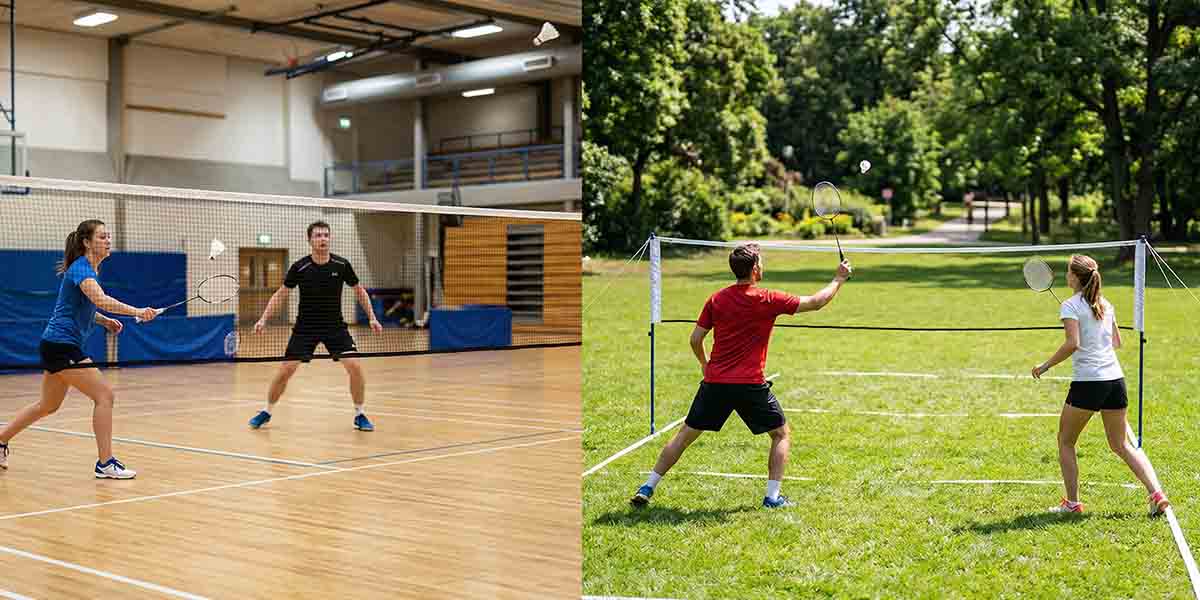
Badminton is one of those sports that looks deceptively simple from the outside. A net, a couple of rackets, a shuttlecock — how complicated can it get? But anyone who has spent time playing the game seriously will tell you that the equipment matters far more than most beginners assume. And nowhere is that more obvious than when you start comparing indoor and outdoor badminton sets.
Whether you are setting up a backyard court for summer gatherings, joining a local club that plays in a sports hall, or somewhere in between, picking the right set can mean the difference between a frustrating afternoon and a genuinely enjoyable game. This guide breaks down everything you need to know about indoor and outdoor badminton sets — what makes them different, what to look for, and how to decide which one actually suits your situation.
Why the Environment Changes Everything
Before getting into the specifics of what each set contains, it helps to understand why indoor and outdoor badminton are treated as two distinct experiences. The answer is almost entirely about the shuttlecock and how it travels through the air.
Badminton is unique among racket sports because the shuttlecock — sometimes called a birdie — is aerodynamically unlike any other projectile in sport. It is heavy at the cork or rubber base and extremely light at the feathered or plastic skirt. This design gives it a very specific flight pattern: it decelerates rapidly after being struck, which is what makes the sport so fast and reactive at close range.
Take that same shuttlecock outdoors and even a mild breeze can completely distort its path. A shot aimed straight across the net can veer sideways by several feet. Players end up chasing the shuttlecock rather than actually playing badminton. This is why outdoor sets use heavier, more wind-resistant shuttlecocks, and why the rackets and even the net systems are built differently to handle the conditions.
| 🎯 What Are You Looking For? | 👉 See Top Picks from Amazon |
|---|---|
| New to badminton? | ⭐ Best Beginner Rackets |
| Want powerful smashes? | ⭐ Best Head Heavy Rackets |
| Play aggressively? | Best Attacking Rackets |
| Prefer ultra-light rackets? | Best Lightweight Yonex Rackets |
| Curious what pros use? | Professional Players’ Rackets |
| Want premium gear? | Most Expensive Badminton Rackets |
| Loyal to Yonex Voltric? | Best Yonex Voltric Series |
Indoor Badminton Sets: Built for Precision and Performance
Indoor badminton is the version you see in the Olympics, club competitions, and school gymnasiums. The game is played in a controlled environment with no wind, consistent lighting, and a smooth, flat floor. Sets designed for indoor play are optimized for this context — they prioritize performance, precision, and the authentic feel of the sport.
Rackets
Indoor rackets are typically lighter and more refined than their outdoor equivalents. A good indoor racket will weigh somewhere between 80 and 95 grams, which might seem trivial but makes a noticeable difference over the course of a long rally. Frames are usually made from graphite or carbon fiber, both of which offer an excellent combination of stiffness and weight. The string tension on indoor rackets tends to be higher — usually between 22 and 30 pounds — which gives players more control and a crisper feel on contact.
The grip is another area where indoor rackets stand apart. Synthetic overgrips or towel grips absorb sweat and maintain feel during extended play. For anyone playing competitively or even semi-seriously in a gym, the grip quality becomes noticeable fairly quickly.
Shuttlecocks
The shuttlecock used indoors is where the biggest difference lies. At the top level, feather shuttlecocks made from goose or duck feathers are the only option. They offer an unmatched flight quality — the natural feathers create a subtle flutter that gives the shuttlecock its characteristic feel and speed drop. Most competitive indoor players insist on feather shuttles despite their cost and fragility.
For club play and recreational indoor use, high-quality nylon shuttlecocks are a practical compromise. They last significantly longer than feather ones and still fly consistently when used in a controlled indoor environment. The key is matching the shuttlecock speed to the playing conditions — shuttlecocks are graded by speed, and a cooler gym will require a faster shuttle than a warm one.
Nets and Posts
Indoor badminton nets are designed to meet BWF (Badminton World Federation) specifications: 5 feet 1 inch high at the edges and 5 feet at the center, stretched across the full 20-foot width of a doubles court. The net itself should have a fine mesh that is tight and consistent. Posts are usually made from aluminum or steel and attach to floor sockets in established sports halls.
For home gym setups or portable indoor use, there are freestanding net systems that clamp or tension into place without floor sockets. These are a workable option as long as they hold their tension properly during play.
Outdoor Badminton Sets: Built for Durability and Wind Resistance
Outdoor badminton is a completely different animal. The game played at a backyard barbecue, a park, or a beach is less about technical precision and more about fun, accessibility, and surviving whatever the weather decides to throw at you. Outdoor sets are designed with these priorities firmly in mind.
Rackets
Outdoor rackets are generally heavier and more robust than indoor ones. Steel or aluminum frames are common at the lower end of the price range, and while serious players might turn up their nose at these materials, they hold up well to being left in the garden shed, dropped on concrete, or handled by players who are not particularly careful with their gear.
String tension on outdoor rackets is typically lower, which actually helps when playing with heavier outdoor shuttlecocks. The lower tension gives more power on each stroke without requiring the same technique that higher-tension strings demand. For casual play, this makes the game more forgiving.
Shuttlecocks
Outdoor shuttlecocks are the most important piece of the puzzle. They are made heavier than standard shuttles specifically to resist wind. Most outdoor shuttles use a plastic skirt with a denser, heavier base — sometimes rubber rather than cork — to keep them flying more predictably in a breeze.
The trade-off is that these shuttlecocks feel quite different from indoor ones. They fly shorter distances, hit harder, and do not have that graceful deceleration that makes indoor badminton so fast-paced. But for a relaxed afternoon in the garden, they work perfectly well and are far more enjoyable than trying to chase a feather shuttle across three garden beds because a gust caught it mid-flight.
Nets and Posts
Outdoor net systems prioritize stability and ease of setup. Ground stakes or weighted bases keep the posts upright without needing a specially prepared surface. The net fabric is often heavier and UV-treated to handle sunlight and rain without deteriorating quickly. Net dimensions in outdoor sets are sometimes slightly different from regulation sizes, which is fine for recreational play.
Good outdoor sets will include guy wires or tensioning straps that help the posts stay upright even on uneven grass. If you are setting up on a hard patio surface, look for posts with rubber feet and sandbag-style base options rather than stakes.
Key Differences at a Glance
To summarize the main distinctions between indoor and outdoor sets:
- Shuttlecocks: Feather or light nylon for indoors; heavy plastic or rubber base shuttles for outdoors
- Racket weight: Lighter graphite or carbon frames for indoors; heavier steel or aluminum for outdoors
- String tension: Higher for indoor precision; lower for outdoor power and forgiveness
- Net posts: Floor socket or freestanding for indoors; stake or weighted base for outdoors
- Net material: Fine mesh for indoors; heavier UV-resistant fabric for outdoors
- Overall durability focus: Performance first for indoors; weather resistance first for outdoors
Can You Use Indoor Equipment Outside, or Vice Versa?
This is a question that comes up often, and the honest answer is: it depends on how serious you are about the experience.
Using outdoor equipment indoors is generally fine for casual play. The heavier shuttlecocks will fly shorter and feel different, but you can still have a good game. The rackets will feel clunkier, but they will work. The main downside is that you lose much of what makes indoor badminton enjoyable — the speed, the precision, the satisfying feel of a well-timed drop shot.
Taking indoor equipment outside is a different story. Feather shuttlecocks outdoors are essentially unusable unless you are playing in perfect, windless conditions — which are rare. A light breeze renders them unpredictable, and a stronger one makes the game unplayable. Indoor rackets will survive outdoors just fine from a durability standpoint, though leaving graphite frames in direct sunlight for extended periods can degrade the resin over time.
The sensible conclusion is this: if you only buy one set and you plan to play both indoors and outdoors, buy an outdoor set and switch to proper indoor shuttlecocks when you play inside. The rackets and net will handle both environments, and you only need to swap the shuttlecocks.
What to Look for When Buying a Badminton Set
Whether you are shopping for an indoor or outdoor set, a few factors apply universally.
Number of Players
Most beginner sets come with two rackets and are designed for singles play or for two people to knock the shuttlecock around. Doubles sets typically include four rackets. If you regularly play doubles — which is far more common than singles in recreational badminton — make sure the set you buy includes enough rackets, or that additional matching rackets are available to purchase separately.
Shuttlecock Quantity
Shuttlecocks get lost, damaged, or wear out faster than most people expect. Outdoor shuttles in particular can get roughed up by landing on patio stone or concrete. Look for sets that include at least six shuttlecocks, and pay attention to whether replacements are easy to find at a reasonable price. Proprietary designs that only work with one brand’s set can become expensive to maintain over time.
Net Quality and Tension
The net is one area where cheaper sets often cut corners. A net that sags in the middle, tangles easily, or loses tension after a few uses is genuinely frustrating to play with. Look for nets with a solid top tape and side tapes that keep the net taut from edge to edge. For outdoor sets, the stability of the post system matters just as much — wobbly posts that shift during play are annoying and can create safety issues.
Carrying Case and Storage
A set that comes with a proper carrying bag or case is worth the slight premium. It keeps everything together, makes transport easier, and protects the rackets from warping or getting damaged in storage. Sets that come bundled in a loose box with no carry solution tend to end up disorganized and partially missing within a season.
Price Ranges and What to Expect
Badminton sets span an enormous price range, from budget garden sets costing under twenty dollars to high-end indoor setups that run into several hundred. Here is a rough guide to what you can realistically expect at each level.
Under $30 — Entry Level
These sets are aimed at families and casual players who want something to pull out at a picnic or garden party. The rackets are steel or aluminum with basic plastic handles, the shuttlecocks are lightweight plastic, and the net is often a shorter version designed for informal play rather than standard court dimensions. Perfectly fine for occasional use, but not built for anything more serious.
$30–$80 — Mid Range
This is where things start to get noticeably better. Rackets in this bracket often have aluminum or entry-level graphite frames with proper grip tape, the net meets regulation dimensions, and the shuttlecocks are more consistent in flight. For regular backyard or recreational club play, this range offers good value. Both indoor and outdoor sets at this price point can give players a solid experience.
$80–$200+ — Serious Recreational and Club
At this level, you are getting genuine graphite rackets, professional-grade nets, and quality shuttlecocks that perform consistently. Indoor sets in this range are suitable for club play, and outdoor sets at this price come with robust post systems and wind-resistant shuttles that genuinely hold up to regular use. If you play more than a handful of times a month, investing in this tier pays off quickly in durability and enjoyment.
Popular Brands Worth Knowing
A few manufacturers have built strong reputations in badminton equipment, and their sets tend to be reliable across different price points.
Yonex is the gold standard in badminton. Their rackets are used by most professional players worldwide, and their recreational sets benefit from the same engineering philosophy. If you want indoor equipment that performs like the real thing, Yonex is where most serious players start.
Victor and Li-Ning are two other brands with strong reputations, particularly in Asia where badminton is played at a much higher level than in most Western countries. Both offer excellent rackets and shuttlecocks at competitive prices.
For outdoor and family sets, Champion Sports, Park & Sun Sports, and Baden all make reliable complete sets that include stable net systems and plenty of shuttlecocks. These are practical, affordable options for families who want something that sets up quickly and holds up to regular outdoor use.
Tips for Getting the Most Out of Your Set
Regardless of which type of set you end up with, a few habits will extend its life and keep your game enjoyable.
- Store rackets indoors when not in use. Even outdoor rackets benefit from being kept dry and out of direct sunlight when stored.
- Keep extra shuttlecocks on hand. Running out mid-session kills the momentum of a game.
- Check the net tension before each session. Nets that sag in the middle need to be retightened, and ignoring this gradually stretches the net fabric out of shape.
- Replace overgrips regularly if you play indoors. A fresh grip improves control significantly and is one of the cheapest upgrades you can make.
- Do not leave feather shuttlecocks in extreme heat or cold. Feathers are sensitive to humidity and temperature, and a tube left in a hot car will come out noticeably worse than when it went in.
Making the Final Decision
If you are still unsure which type of set to buy, the answer usually lies in honestly answering one question: where will you play most often?
If the answer is a sports hall, community center, or any enclosed venue — even if you might play outside occasionally — go with an indoor set and pick up some heavier outdoor shuttlecocks as a backup. You will get the full benefit of proper indoor equipment for your main game while still being able to venture outside when the weather is right.
If the answer is your backyard, a park, or any outdoor setting — buy an outdoor set without hesitation. The wind-resistant shuttlecocks and sturdy net system will make the game so much more enjoyable that you will wonder why you ever tried to use anything else outside.
For players who genuinely split their time equally, the compromise route — outdoor rackets and net, with two sets of shuttlecocks — works well and does not require investing in two complete sets.
Conclusion
Badminton is a sport that rewards good equipment. The gap between playing with the right set and playing with the wrong one is significant — not just in terms of performance, but in how much fun you actually have. Indoor and outdoor badminton sets are designed for genuinely different conditions, and understanding those differences takes the guesswork out of buying.
Whether you are chasing a shuttlecock across a backyard or trading drops and smashes at a local club, having equipment that is built for your environment makes every shot feel better. Take the time to choose well, and the sport will reward you for it.
| 🏸 Need Better Comfort & Performance? | 👉 Explore Top Picks from Amazon |
|---|---|
| Want better grip on court? | ⭐ Best Non-Marking Badminton Shoes |
| Just starting out? | Best Beginner Badminton Shoes |
| Carry gear like a pro? | Best Badminton Bags |
| Confused about string tension? | Best String Tension Guide + Top Strings |
| Need an all-in-one starter kit? | Portable Badminton Racket Sets |
| Protect your eyes during fast rallies? | Best Badminton Glasses |
| Upgrade your court style? | Comfortable Badminton Outfits |






Add comment