
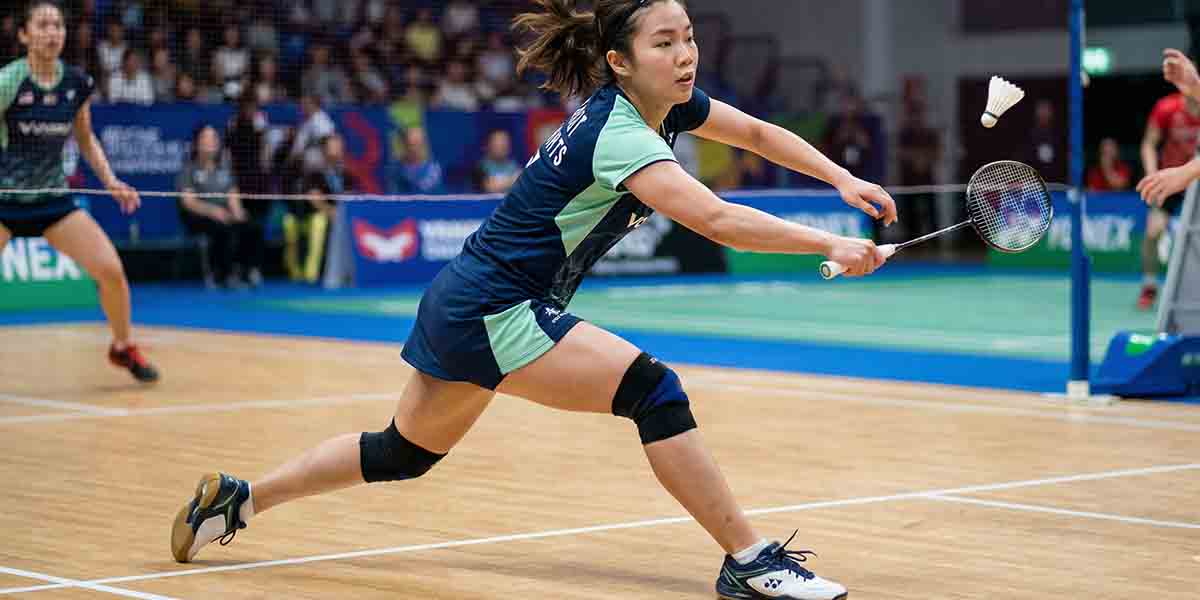
Badminton is one of the fastest racket sports in the world, and women who play it — whether casually on weekends or at a competitive club level — know that it demands far more than just a decent swing. The game tests your speed, your stamina, your ability to read the opponent, and your composure when the shuttle drops just out of reach for the third time in a row.
This guide is written for women players at all stages — beginners who are still figuring out the basic strokes, intermediates who have hit a frustrating plateau, and competitive players looking to sharpen the finer details of their game. There are no shortcuts here, but there are clear, practical things you can start working on right away.
1. Get Your Grip Right Before Anything Else
A surprising number of players, even those who have been playing for years, hold their racket incorrectly. The grip affects everything — the power you can generate, the angles you can create, and how quickly your wrist can snap through a shot. If your grip is wrong, you are fighting the racket instead of working with it.
The basic forehand grip is sometimes called the handshake grip — hold the racket handle as though you are shaking someone’s hand. Your thumb should rest comfortably on the side of the handle, and your fingers should wrap around naturally without squeezing tightly. Many beginners grip the racket as if it might fly out of their hand. That tension travels up your arm and kills your stroke.
For backhand shots, rotate the racket slightly so your thumb sits flat against the wider surface of the handle. This gives you leverage when pushing the shuttle across court, which is where many women struggle — the backhand clear, hit with real pace, requires that thumb to do some work.
Check your grip regularly during practice. Many players unconsciously shift toward a tighter, more awkward grip when they get tired or nervous. Consciously loosening up between points is a good habit to build.
| 🎯 What Are You Looking For? | 👉 See Top Picks from Amazon |
|---|---|
| New to badminton? | ⭐ Best Beginner Rackets |
| Want powerful smashes? | ⭐ Best Head Heavy Rackets |
| Play aggressively? | Best Attacking Rackets |
| Prefer ultra-light rackets? | Best Lightweight Yonex Rackets |
| Curious what pros use? | Professional Players’ Rackets |
| Want premium gear? | Most Expensive Badminton Rackets |
| Loyal to Yonex Voltric? | Best Yonex Voltric Series |
2. Footwork: The Part of the Game Nobody Talks About Enough
If you watch a skilled player closely, what you notice is not so much their racket work as their feet. They always seem to be in position. The shuttle never catches them leaning the wrong way or scrambling from the wrong side. That is footwork, and it is the foundation of everything.
The base position is the starting point. After every shot, you should return to roughly the center of the court — slightly toward the rear if you have just hit a net shot, slightly forward if you have just played a smash. This gives you the best chance of reaching whatever comes back.
Moving to the four corners of the court — front left, front right, rear left, rear right — follows specific patterns. Going to the rear corners on your forehand side, most players use a small skip step and then a lunge or a scissor kick to reach the shuttle. Going to the backhand rear corner is harder and requires more deliberate practice.
Simple Footwork Drills to Practice on Your Own
- Shadow badminton: Move to each corner of the court and back to base without a shuttle, focusing on how your feet land and push off. Do this for two-minute sets.
- Ladder drills: Agility ladders are useful for sharpening the quick, small steps that get you into position before a bigger movement.
- Side-to-side sprints across the width of the court help build the lateral speed that saves you during long rallies.
3. Mastering the Core Strokes
There are a handful of strokes that form the backbone of any women’s game. Getting these right — and knowing when to use each one — makes a bigger difference than learning fancy shots.
The Clear
The overhead clear sends the shuttle high and deep to the opponent’s back court. It is your most important defensive weapon and also a way to reset a rally when you are under pressure. A good clear gives you time to recover your position. A weak clear — one that lands short — gives your opponent an easy smash.
To hit a powerful clear, get behind the shuttle, point your non-racket shoulder toward the net as you prepare, and throw your racket arm through a full arc, snapping your wrist at the point of contact. The wrist snap is what generates pace.
The Drop Shot
A well-disguised drop shot — one that looks like a clear until the last moment — is one of the most effective weapons in women’s singles and doubles. The preparation should be identical to the clear. Instead of a full wrist snap, you slow down the racket head and guide the shuttle just over the net with a slight angle. The shuttle should land as close to the net as possible while still clearing it.
The Smash
The smash is the most aggressive shot in the game, but it is also the most energy-expensive. Many women, particularly at club level, smash every chance they get, which leads to fatigue and errors. The smash works best when your opponent is out of position — when they are pushed wide or deep, giving you an open court to aim at.
Contact the shuttle as high as possible and in front of your body, not level with your shoulder. Aim down at a sharp angle and aim for the body or the back corner of the court rather than always going cross-court, which is predictable.
The Net Shot
Close to the net, delicacy matters more than power. A good net shot tumbles just over the tape and dies close to the net on the other side. The best players use a very soft grip and a gentle pushing motion rather than a stroke. Rushing net shots is a common error — slow down your racket approach as you get close to the net.
4. Serving: Your Free Chance to Take Control
In badminton, the serve is not as dominant as in tennis, but a good serve still sets the tone for the rally. A bad serve gives your opponent an immediate attack.
In doubles, the low serve is the standard first choice. Served from close to the service line, just skimming the net and landing in the front of the opponent’s service box, it denies them any angle for a strong reply. The key is consistency — the serve must stay low, because a serve that rises gives your opponent a chance to attack from above the tape.
In singles, the high serve — deep to the back corners — is often more useful because it pushes your opponent behind the court and gives you time to move forward. However, do not become predictable. An occasional flick serve to the back corners when your opponent is anticipating a low one can win points outright.
Practice your serve separately, not just at the start of a session. Spend fifteen minutes doing nothing but serves, checking both the height over the net and where the shuttle lands. Consistency on the serve under pressure comes from repetition.
5. Women’s Doubles: Rotation and Communication
Doubles badminton has its own logic, and the most successful women’s pairs do not just play as two individuals sharing a court. They function as a unit, with clear roles and constant rotation.
When your pair is attacking — when you have just smashed or played a tight net shot — one player should be at the front and one at the rear. The rear player looks to smash or drive, and the front player looks to intercept or put away anything that comes soft to the net.
When defending — when your opponents are attacking — move to a side-by-side formation. Each player takes responsibility for half the court.
Communication is something many club pairs neglect. Calling out ‘mine’ or ‘yours’ for middle shots, discussing between rallies what you are trying to do tactically, and agreeing on who covers the short serve return — all of this reduces confusion and prevents the gaps that good opponents will find.
One very practical tip for mixed doubles: if you are the woman in a mixed pair, do not let opponents constantly target you with flat, fast shots aimed at your body. Stay more to the center, watch the shuttle early, and make it clear that you are comfortable at the net so your opponents cannot easily ignore you.
6. Physical Fitness: Train Smarter, Not Just Harder
Badminton is physically demanding in a specific way. Rallies are short but extremely intense, followed by brief rest periods. This stop-start pattern — repeated dozens of times over a match — requires a very particular kind of fitness.
Aerobic Base
A solid aerobic foundation helps you recover between rallies. Running, cycling, or swimming two to three times a week builds this base. Many players find that their fitness feels adequate in short practice sessions but deteriorates in a third game when they are genuinely tired. That is usually an aerobic base problem.
Interval Training
Intervals — sprinting hard for 15-30 seconds, then resting, then going again — more closely mimic what your body experiences during a match. Court sprints, shuttle runs (the running kind, not the feathered kind), and bicycle intervals are all useful.
Strength and Injury Prevention
Women badminton players are particularly prone to knee injuries, ankle sprains, and shoulder problems. Some basic gym work goes a long way toward preventing these:
- Strengthening the muscles around the knee — squats, lunges, and step-ups — protects against the sudden changes of direction the game demands.
- Ankle stability exercises, including single-leg balances and resistance band work, reduce the risk of the most common badminton injury.
- Shoulder rotator cuff exercises, done with light resistance bands, protect the joint that does so much work during smashes and clears.
7. Tactical Thinking: Play the Opponent, Not Just the Shuttle
Improving your strokes and fitness will take your game a long way, but the players who genuinely compete well have also developed the habit of thinking tactically during a match.
Watch your opponent in the first few rallies, not just the shuttle. Which side do they favor going to? Do they struggle with shots to their body? Do they move faster forward or backward? Every player has patterns, and those patterns become more pronounced under pressure.
One common tactical mistake among women players is playing too many shots to where their opponent is standing. Vary the direction constantly. Make your opponent move. A player who is chasing the shuttle is a player who cannot set up a strong attack.
Change of pace is another underused tactic. Most club players develop a natural tempo and stick to it throughout a match. Deliberately slowing down a rally — with high clears and patient net play — and then suddenly accelerating with a flat drive can unsettle opponents who have found a comfortable rhythm.
In the third game, or late in a tight second game, simplify. The time to experiment is not when a match is on the line. Go back to your most reliable shots and execute them with control.
8. The Mental Side: Staying Focused Under Pressure
Many players — and this applies to women at every level — are technically capable of playing far better than they do in matches. The gap between practice performance and match performance is almost always a mental one.
Nerves are normal. The racing heart before a match, the slight shakiness in the first few rallies — these are signs that your body is preparing for competition. The question is not how to eliminate nerves but how to work with them.
One straightforward strategy is to focus on process rather than outcome. Instead of thinking about the score or whether you will win, focus on one specific thing per rally: getting back to base position, keeping your clears deep, watching the shuttle all the way to your racket. This gives your mind something concrete to do other than worry.
Develop a routine between points. A slow breath, a brief walk to the back of the court, bouncing on your heels before returning to the ready position — whatever small ritual helps you reset between rallies. Top players use these micro-routines to manage the psychological rhythm of a match.
When you make errors — and you will, everyone does — give yourself a few seconds to acknowledge it and move on. Players who dwell on mistakes for three or four rallies tend to compound them. A short, deliberate reset is more useful than either pretending the error did not happen or replaying it endlessly in your head.
9. Equipment: What Actually Matters
You do not need the most expensive racket on the market, but you do need equipment that suits your game.
Racket weight and balance matter more than the brand name. A head-heavy racket generates more power on smashes but requires more strength to maneuver quickly. A head-light racket is faster for net play and drives but gives you less natural power from the back. Most women at an intermediate level find an even-balanced racket to be the most versatile starting point.
String tension significantly affects feel. Low tension (around 22-24 pounds) is more forgiving and generates more power with less effort, which suits beginners and recreational players. Higher tension gives more control but demands better technique and timing. Get your racket restrung every few months if you play regularly — strings lose tension over time and a slack string bed mutes your feel for the shuttle.
Footwear is perhaps the most important equipment decision for injury prevention. Badminton shoes have non-marking rubber soles designed for lateral movement on the court. Running shoes have cushioning built for forward movement and can actually increase your ankle injury risk on a badminton court. Invest in proper badminton or indoor court shoes.
10. Building Good Habits in Practice
How you practice matters as much as how often you practice. There is a temptation in club sessions to just play games. Games are fun and they do develop certain instincts, but deliberate drill work is what actually fixes technical problems.
Identify one specific weakness each week and spend part of every session working on it. If your backhand clear is weak, hit two hundred backhand clears this week. If your net shots land too long, spend twenty minutes doing nothing but net shots, focusing on the moment of contact. Progress in badminton tends to come in these focused chunks of deliberate work.
Find a drilling partner who is honest with you. Someone who tells you when your drop shot preparation is giving it away is more useful than someone who lets you practice bad habits without comment.
Recording yourself on a phone occasionally is surprisingly useful. What feels like a good smash technique often looks quite different on video. Watching yourself play, even briefly, has a way of making obvious the things a coach has been trying to tell you for months.
A Final Word
Women’s badminton rewards patience. The players who improve most consistently are not necessarily the most naturally gifted or the most athletic — they are the ones who keep showing up, keep working on their weaknesses, and keep competing even when the results are not going their way.
Pick two or three of the areas in this guide that feel most relevant to where you are right now, and concentrate on those for the next month. You do not need to overhaul your entire game at once. Small improvements, stacked over time, add up to something genuinely significant.
And enjoy the game. Badminton, at any level, is a sport that rewards creativity, cleverness, and grit in equal measure. Those are qualities worth developing on and off the court.
| 🏸 Need Better Comfort & Performance? | 👉 Explore Top Picks from Amazon |
|---|---|
| Want better grip on court? | ⭐ Best Non-Marking Badminton Shoes |
| Just starting out? | Best Beginner Badminton Shoes |
| Carry gear like a pro? | Best Badminton Bags |
| Confused about string tension? | Best String Tension Guide + Top Strings |
| Need an all-in-one starter kit? | Portable Badminton Racket Sets |
| Protect your eyes during fast rallies? | Best Badminton Glasses |
| Upgrade your court style? | Comfortable Badminton Outfits |







Add comment