
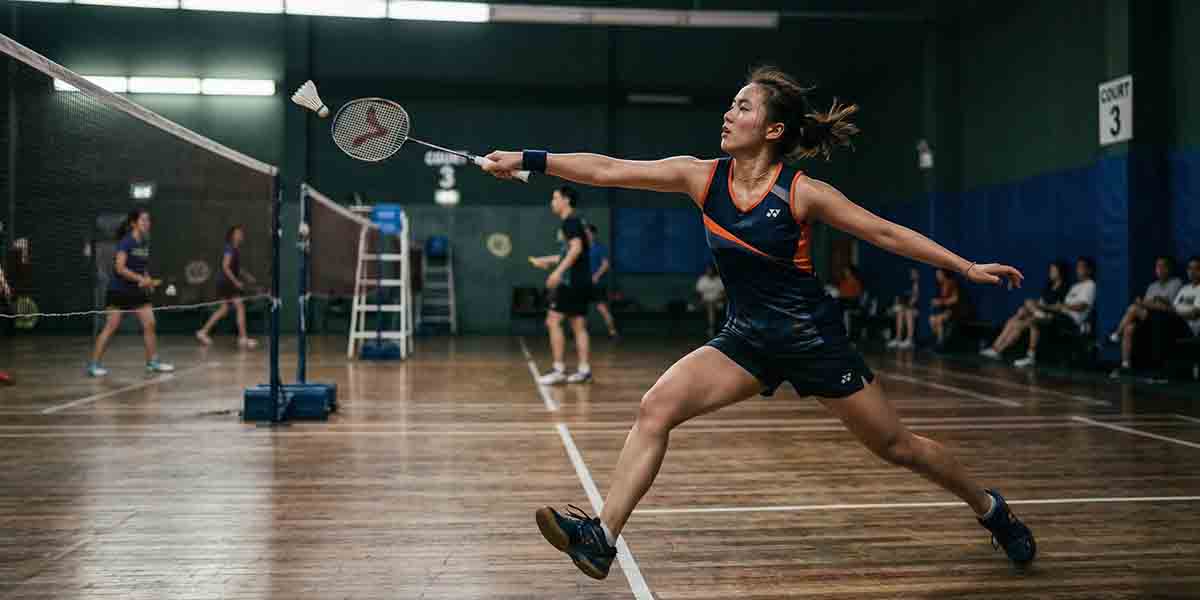
There is something special about badminton. It is a sport that looks simple from the outside — two people or four people hitting a shuttlecock back and forth across a net — but anyone who has played it seriously knows it is far more than that. Badminton demands speed, agility, sharp thinking, and above all, a relentless will to keep going.
Whether you are a weekend player at the park or someone who trains six days a week with ambitions of competing at a higher level, the game has a way of pushing you, testing you, and ultimately, motivating you to become better.
This article is about that motivation — the kind that badminton builds inside you over time, the kind that carries you through tired legs and missed shots, and the kind that keeps you coming back to the court day after day.
Why Badminton Gets Under Your Skin
Ask any badminton player why they play, and most of them will pause for a second before answering. It is hard to put into words. Part of it is the speed — badminton is officially the fastest racket sport in the world, with shuttlecocks recorded at over 300 kilometers per hour in professional matches. There is a rush that comes from reacting to that speed, from moving your body quickly enough to make a shot that, a split second earlier, seemed impossible to reach.
But it is not just the speed. It is the feeling of improvement. When you first pick up a racket, the shuttlecock seems to go wherever it pleases. Your drops fall into the net. Your smashes fly long. You feel clumsy and frustrated. But then something clicks. A week later, you make a clean cross-court drop shot. A month after that, you win your first competitive rally against someone better than you. These small victories are what keep people hooked.
Badminton rewards patience and persistence like few other sports. You cannot buy skill in this game. You have to earn it, one session at a time, one footwork drill at a time, one rally at a time. That process is, in itself, deeply motivating.
| 🎯 What Are You Looking For? | 👉 See Top Picks from Amazon |
|---|---|
| New to badminton? | ⭐ Best Beginner Rackets |
| Want powerful smashes? | ⭐ Best Head Heavy Rackets |
| Play aggressively? | Best Attacking Rackets |
| Prefer ultra-light rackets? | Best Lightweight Yonex Rackets |
| Curious what pros use? | Professional Players’ Rackets |
| Want premium gear? | Most Expensive Badminton Rackets |
| Loyal to Yonex Voltric? | Best Yonex Voltric Series |
The Mental Game: Staying Strong Between the Lines
Badminton is as much a mental sport as it is a physical one. A lot of what separates good players from great players is not their technique or fitness — it is what goes on in their head during a match. Staying focused when you are down by ten points, resisting the urge to panic, slowing down your breathing and trusting your training — these are the qualities that define champions at every level of the game.
Many players have experienced the feeling of being down 10-19 in the final game, seemingly moments away from losing, only to claw their way back point by point and win. Those comebacks are not just exciting to watch. They are lessons in resilience that stay with you long after the match is over. They remind you that the game is never finished until the last shuttle hits the floor.
This mental toughness that badminton builds does not stay on the court. Players often find that the same determination they develop during a hard match shows up in their work, in their studies, and in how they handle setbacks in daily life. The sport teaches you to stay composed under pressure, to problem-solve quickly, and to believe in your own abilities even when things are not going your way.
That is a lesson worth far more than any trophy.
Role Models Who Inspire Every Shuttle Strike
One of the most powerful sources of motivation in badminton is the incredible history of players who have shown the world what is possible through dedication and hard work. The sport has given the world stories that are genuinely worth telling — not just as sporting achievements, but as human ones.
Lin Dan of China, widely considered one of the greatest players in the history of the sport, is a study in sustained excellence. He won back-to-back Olympic gold medals, five World Championships, and dominated the sport for over a decade. What is remarkable about his story is not just the titles but the fact that he kept rebuilding and reinventing himself every time rivals came close to catching him. He never allowed complacency to take hold.
P.V. Sindhu of India became one of the most recognizable names in her country’s sporting history by reaching the Olympic final in 2016 and eventually winning gold at the 2019 World Championships. Her journey was built on years of grueling early morning training sessions, countless defeats, and an absolute refusal to lower her sights. She grew up making long daily commutes to her training academy and missed out on much of the typical childhood experience to pursue her dream. And she made it.
These players, and many others like them, are proof that consistent effort over time produces results. They did not become great overnight. They became great because they showed up, day after day, and refused to stop improving.
The Community That Keeps You Going
One thing that often gets overlooked when people talk about what motivates badminton players is the community. Walk into any badminton hall on a weekday evening, and you will find people of all ages — retired teachers playing doubles with teenagers, office workers shaking off the stress of the day, beginners just learning to serve, seasoned club players who have been at it for thirty years. The badminton community is warm, welcoming, and quietly encouraging.
There is a culture of shared improvement in most badminton clubs. Better players rarely look down on beginners. Instead, they pull them along — offering a tip here, a drill suggestion there, or simply a game that pushes the newer player just a little beyond their comfort zone. That culture of mutual growth is one of the reasons people stay in the sport for decades.
Motivation is often something we think of as an internal force — something we either have or do not have on a given day. But the truth is, the people around us shape our motivation enormously. Being part of a group that trains hard, supports each other, and celebrates each other’s progress makes it much easier to lace up your shoes and get on the court even when you do not feel like it.
Fitness, Energy, and the Motivation Loop
There is a well-documented relationship between physical activity and motivation. Exercise releases endorphins that improve mood and sharpen focus. Badminton, which combines aerobic endurance with explosive movements and fast reaction times, is particularly effective in this regard. A single hour on the court can leave you feeling more energized and mentally clear than you did going in — even if you were exhausted when you arrived.
This creates a positive feedback loop. You play, you feel better, you want to play again. You get fitter, your game improves, you want to play more. You meet people at the club, you look forward to seeing them, you want to play more. Over time, badminton becomes less of an activity you do and more of a part of who you are.
Unlike some forms of exercise that can feel like a chore, badminton rarely does. The competitive element keeps the mind engaged, the social element keeps it enjoyable, and the constant learning curve keeps it fresh. That combination is genuinely hard to find in a single activity.
When Things Get Hard: Pushing Through the Plateaus
Every serious player hits a plateau at some point. You have been playing for two years, you have gotten quite good, and then suddenly it feels like you are not improving at all. You lose to people you used to beat. Your shots feel off. Your court movement feels slow. Nothing seems to be working.
This is one of the most critical moments in any athlete’s journey, not just in badminton. The players who push through plateaus are the ones who keep growing. The ones who do not often drift away from the sport altogether.
What gets players through these difficult stretches is almost always a combination of the same things: returning to basics, seeking coaching or feedback, setting new short-term goals, and remembering why they started playing in the first place. Sometimes the solution is taking a short break and coming back refreshed. Sometimes it is committing to a new training focus — improving footwork, for example, or adding strength training to support explosive movement.
The plateau is not a sign that you have reached your limit. It is usually a sign that your current approach has taken you as far as it can and it is time to try something different. Players who understand this are not deterred by plateaus. They use them as signals to adapt and grow.
Setting Goals That Pull You Forward
One of the most practical ways to stay motivated in badminton is to set clear, meaningful goals. These do not have to be grand. A goal might be as simple as learning to execute a reliable backhand clear, winning a set off someone at your club who has always beaten you, or playing in your first tournament. The size of the goal matters less than the fact that it gives you something specific to work toward.
Good goals in badminton tend to be layered — there are big, long-term goals that might take years, medium-term goals that take months, and short-term goals that can be accomplished in a week or even a single session. Having goals at each level means you always have something within reach to celebrate, even while you are still working toward something bigger.
Write your goals down. Talk about them with your coach or your training partner. Track your progress. The act of making your goals visible and concrete makes them feel real — and real goals are far more motivating than vague wishes.
What Badminton Teaches Beyond the Court
Perhaps the most underappreciated thing about badminton is what it teaches you as a person. The sport is a relentless mirror. It shows you how you respond to failure. It shows you whether you are willing to work on your weaknesses or whether you prefer to coast on your strengths. It shows you whether you can remain gracious in victory and dignified in defeat.
Players who take badminton seriously tend to develop a particular kind of character — disciplined, focused, competitive but fair, and genuinely respectful of hard work. These traits do not appear overnight. They are built through thousands of hours on the court, through losses that sting and wins that feel earned.
Children who grow up playing badminton often carry its lessons into their adult lives in ways they may not even realize. The patience they learned waiting for the right moment to attack a shuttle becomes the patience they bring to a long project at work. The discipline they developed showing up to early morning training becomes the discipline they apply to their health, their studies, and their relationships.
Badminton is not just a sport. It is a school for life.
Practical Ways to Stay Motivated in Badminton
Here are some tried-and-true approaches that experienced players use to keep their motivation alive:
- Train with a partner who is slightly better than you. A partner who challenges you will push your game forward far more effectively than one at the same level.
- Watch professional matches regularly. Watching elite players compete does something to your own game mentally — it raises your sense of what is possible and gives you new shots and strategies to try.
- Keep a training journal. Write down what you worked on, what improved, and what you want to focus on next. Seeing your own progress in writing is a powerful motivator.
- Enter competitions, even when you feel you are not ready. Tournament play exposes weaknesses that practice alone never will, and the experience of competing is irreplaceable.
- Celebrate small wins. Did you finally land that jumping smash? Did you win a game against someone you have never beaten before? These moments matter. Acknowledge them.
- Rest without guilt. Motivation suffers when the body and mind are worn down. Rest is not laziness — it is part of the process. Come back fresh and you will find motivation waiting for you on the court.
Conclusion: The Court Always Calls You Back
Badminton has a way of staying with you. Long after you leave the court, you find yourself thinking about the rally you should have won, the drop shot you want to practice, the serve you are going to try next time. That mental engagement — the way the sport occupies your mind even when you are not playing — is part of what makes it so motivating.
The game does not ask you to be perfect. It asks you to keep showing up. It asks you to put in the work, to be honest about your weaknesses, to compete with full effort, and to respect the process. Do those things, and the improvement will come. The satisfaction will come. And the motivation — far from fading — will only grow stronger.
Every great player you have ever admired started exactly where you are now — holding a racket, watching the shuttle fall at their feet, wondering if they would ever get it right. They kept going. That is the entire story.
So keep going.
| 🏸 Need Better Comfort & Performance? | 👉 Explore Top Picks from Amazon |
|---|---|
| Want better grip on court? | ⭐ Best Non-Marking Badminton Shoes |
| Just starting out? | Best Beginner Badminton Shoes |
| Carry gear like a pro? | Best Badminton Bags |
| Confused about string tension? | Best String Tension Guide + Top Strings |
| Need an all-in-one starter kit? | Portable Badminton Racket Sets |
| Protect your eyes during fast rallies? | Best Badminton Glasses |
| Upgrade your court style? | Comfortable Badminton Outfits |







Add comment