
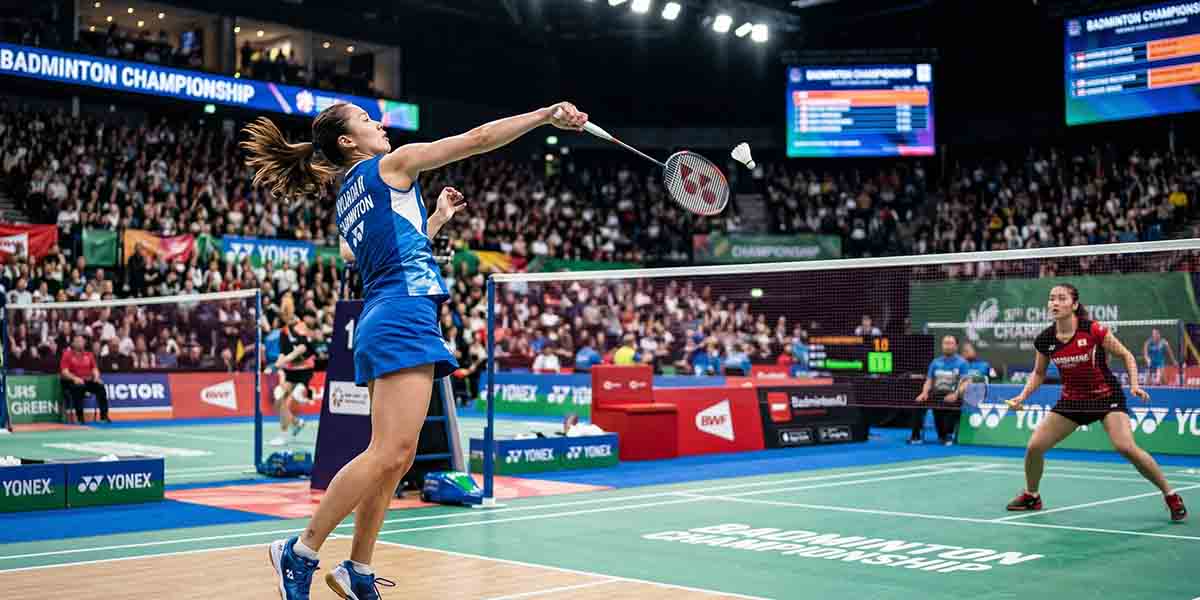
Badminton holds a unique position in the world of racket sports. It is fast, demanding, and deceptively technical. A shuttlecock can travel at speeds exceeding 400 kilometres per hour off a professional smash, yet the same sport asks for extraordinary touch, patience, and court awareness from its players.
Whether you are a weekend club player trying to understand how tournaments work, a parent supporting a junior athlete, a coach preparing a team for competition, or simply someone who has discovered a passion for the game, this guide is written with you in mind.
This article covers the full landscape of badminton competition — from the way local club tournaments are structured, all the way up to the biggest stages in the world: the Olympics, the BWF World Championships, and the prestigious All England Open. Along the way, you will find explanations of scoring systems, draw formats, ranking mechanisms, equipment regulations, and the histories of the tournaments that have shaped the sport.
Badminton has more than 200 million active players worldwide, making it one of the most widely played sports on the planet. Despite this reach, it remains underappreciated in many Western countries where it is often dismissed as a backyard pastime. The competitive reality is something else entirely. A singles rally at the elite level can involve dozens of deceptive strokes, explosive lateral movements, and calculated psychological pressure. Understanding the competitive structure of the sport adds an entirely new dimension to watching or playing it.
1. A Brief History of Competitive Badminton
The origins of badminton as a formal competitive sport trace back to mid-nineteenth century England. The Duke of Beaufort introduced a version of the game at his estate in Gloucestershire — a place called Badminton House — around 1873, though variations of shuttlecock games had existed for centuries across Asia and Europe. The Poona game, brought back by British officers from India, served as a direct precursor.
The Bath Badminton Club established the first formal rules in 1877. The Badminton Association of England was founded in 1893, and the first All England Open Badminton Championships were held in 1899 — making it the oldest badminton tournament in the world still held today. For the first half of the twentieth century, England and Denmark dominated the sport internationally.
The Badminton World Federation (BWF), originally called the International Badminton Federation, was founded in 1934 with nine founding member nations. The Thomas Cup — the men’s team world championship — began in 1948, followed by the Uber Cup for women in 1957. These team events remain among the most celebrated in the sport. Badminton became an Olympic sport at the 1992 Barcelona Games, a milestone that transformed the sport’s global profile almost overnight.
The late twentieth century saw Asian nations, particularly China, Indonesia, South Korea, Malaysia, and later India and Japan, become the dominant forces. China’s rise from the 1980s onward reshaped the competitive landscape permanently. Today, the BWF has over 190 member associations, and the sport’s professional circuit spans dozens of countries.
| 🎯 What Are You Looking For? | 👉 See Top Picks from Amazon |
|---|---|
| New to badminton? | ⭐ Best Beginner Rackets |
| Want powerful smashes? | ⭐ Best Head Heavy Rackets |
| Play aggressively? | Best Attacking Rackets |
| Prefer ultra-light rackets? | Best Lightweight Yonex Rackets |
| Curious what pros use? | Professional Players’ Rackets |
| Want premium gear? | Most Expensive Badminton Rackets |
| Loyal to Yonex Voltric? | Best Yonex Voltric Series |
2. Tournament Formats & Draw Structures
Understanding how tournaments are organised is essential both for participants and spectators. There is no single universal format; the structure depends on the level of competition, the number of entries, the time available, and the resources of the organising body.
2.1 Single Elimination (Knock-Out)
The single-elimination format is the simplest and most widely used in professional badminton. Players or pairs are drawn into a bracket. Each round eliminates the loser, and the winner advances until one player or pair remains. This format is clean, time-efficient, and builds toward a clear final.
Most BWF World Tour events and major championships use seeding to protect the highest-ranked players from meeting too early. Seeds are placed in different sections of the draw, ensuring — in theory — that the best players face each other only in the later rounds. Unseeded players are drawn randomly into the remaining slots.
2.2 Round Robin (Group Stage)
In a round robin format, every participant plays against every other participant in their group. Points are awarded for wins, and the players with the most points advance to a knock-out phase or are ranked accordingly. This format is fairer in some respects — a single bad day does not end your tournament — but it requires considerably more time.
The BWF World Tour Finals, held at the end of the season, uses a group stage followed by semi-finals and a final. Eight players or pairs in each discipline are divided into two groups of four. The top two from each group advance to the semi-finals. This structure rewards consistent performance across the season since qualification itself depends on accumulated World Tour points.
2.3 Double Elimination
Less common in badminton but occasionally used at lower levels, double elimination allows players to lose once and still continue in a losers’ bracket. Only a second loss sends a player home. The winners’ bracket and losers’ bracket eventually meet at the final. This format is popular in some team sports and games but can be logistically complex for badminton given court availability constraints.
2.4 Team Competition Format
Team events like the Thomas Cup, Uber Cup, Sudirman Cup, and BWF Team World Championships use a tie format. Each tie between two nations consists of five matches: two singles, one doubles, and two more singles in most formats (though specific events may vary slightly). A nation wins the tie by winning three of the five matches, and the outcome of unplayed matches does not matter once the result is decided.
Within these events, group stages are used to whittle down the field before a knock-out phase. The team event format adds a layer of strategy absent in individual tournaments — coaches must decide how to deploy their best players and whether to reveal line-ups in advance or respond to the opposing team’s selection.
3. Scoring System & Rules of Play
The BWF adopted the current scoring system in 2006 after years of experimentation. The change from the old “service scoring” to a “rally point” system significantly altered the nature of competition.
3.1 The Rally Point System
Under the current system, a point is scored on every rally regardless of who served. Matches are best of three games. Each game is played to 21 points, and a player or pair must win by two clear points. If the score reaches 20-20, play continues until one side leads by two points. If the score reaches 29-29, the next point wins — there is no sudden death before that, but 30 points is the absolute ceiling for any game.
The side winning a rally scores a point and serves next. If the serving side wins the rally, it scores a point and continues to serve. If the receiving side wins the rally, it scores a point and becomes the new server. This continuous point-scoring ensures that every shot in every rally matters, and momentum swings are immediately reflected on the scoreboard.
3.2 Service Rules
Service rules in badminton are specific and have evolved in recent years. The BWF introduced a fixed service height rule in 2018, requiring the entire shuttlecock to be below 1.15 metres from the court surface at the moment of impact. This replaced a more subjective rule about waist height and was intended to curb the increasingly powerful flick serves seen at the top level.
The server must stand within the service court without touching the lines, the shuttle must be hit below the service height limit, and the racket must move in a continuous forward direction. The receiver must stand in the diagonally opposite service court. In doubles, partners must not obstruct the opponent or distract them during the serve.
3.3 Faults & Lets
A fault results in the loss of a rally. Common faults include hitting the shuttle outside the court boundaries, hitting it into the net, carrying or throwing the shuttle rather than striking it cleanly, a player being hit by the shuttle, touching the net with the racket or body during play, and obstructing an opponent. Service faults also exist — serving too high, serving after the receiver is not ready, or a foot fault during the service motion.
A let is called when a rally must be replayed for reasons outside either player’s control — for example, a shuttle from another court entering the playing area, or genuine uncertainty about whether a service fault occurred. Lets are relatively rare in professional play but important to know about for organised competition.
4. The BWF World Tour — Professional Circuit
The BWF World Tour is the premier professional circuit for individual badminton. Launched in 2018 as a replacement for the Superseries, it restructured the prize money, ranking points, and prestige levels of the professional circuit into a coherent global calendar.
4.1 Tournament Tiers
The World Tour is divided into six tiers based on prize money and ranking points:
- Super 1000 — The highest tier of World Tour events, offering the most prize money and ranking points. Currently includes the All England Open, Malaysia Open, Indonesia Open, China Open, and a handful of others.
- Super 750 — Prestigious events with significant prize money. Includes the French Open, Denmark Open, Fuzhou China Open, and others.
- Super 500 — Strong international events drawing elite players. The India Open, Swiss Open, and Korea Open fall into this tier.
- Super 300 — Well-established events on the professional circuit. The German Open, Canadian Open, and several others.
- Tour Super 100 — Developing events and regional tournaments with international field entries.
- BWF World Tour Finals — Season-ending event featuring the top eight finishers in the ranking across each discipline.
The tier system ensures players understand what is at stake at each event. A Super 1000 winner earns significantly more ranking points than a Super 300 champion, which incentivises the strongest players to enter the most prestigious tournaments.
4.2 Qualification & Player Rankings
The BWF Race to World Tour Finals ranking determines which players earn a spot in the season-ending event. This ranking accumulates points from World Tour events throughout the season. Entry into the major Super 1000 and Super 750 events is also governed by the BWF World Rankings — a rolling twelve-month accumulation of points from all recognized international events.
Higher-ranked players receive direct acceptance into events, while lower-ranked players may need to go through qualifying rounds or depend on wild cards granted by the host association. Managing one’s tournament schedule becomes a significant strategic consideration — playing more events earns more points but risks injury and fatigue.
5. The Major Championships
5.1 BWF World Championships
First held in 1977 in Malmö, Sweden, the BWF World Championships is the most important individual title in badminton outside of the Olympics. It is held annually (with the exception of Olympic years, where it historically was not staged, though this practice changed in more recent cycles). The event covers five disciplines: men’s singles, women’s singles, men’s doubles, women’s doubles, and mixed doubles.
China has dominated the World Championships more than any other nation. Players like Lin Dan, who won the men’s singles title five times, and Carolina Marin of Spain, a three-time women’s singles champion, stand among the sport’s greatest competitors. The World Championships use a single-elimination format after a qualifying round, with seedings applied to protect the top players.
5.2 The Olympics
Badminton made its Olympic debut at Barcelona 1992, initially with four disciplines. Mixed doubles was added at the Atlanta 1996 Games. Olympic badminton carries extraordinary cultural weight in Asia, where success at the Games is treated as a matter of national pride. Entire countries pause to watch their stars compete.
Qualification for the Olympics is based on BWF World Rankings over a specified period, with a maximum of two players or pairs per nation per discipline. The Olympic badminton format uses a group stage followed by a single-elimination knockout. The mixed doubles controversy at London 2012 — where several pairs were disqualified for deliberately trying to lose group-stage matches to secure more favourable draws — led to significant rule changes at subsequent Games.
5.3 The All England Open
Founded in 1899, the All England Open holds a special place in the history of the sport. For decades it was the unofficial world championship of badminton, drawing the best players from around the globe before the BWF World Championships existed. Even today, with dozens of higher-profile events on the calendar, winning the All England retains immense prestige.
Held in Birmingham, England, the event is a Super 1000 tournament on the BWF World Tour. The arena atmosphere is unlike almost any other badminton event — the history of the venue and the sport’s British origins add a particular weight to competing and winning there. Denmark’s Mads Pieler Kolding, Indonesia’s Taufik Hidayat, and China’s Zhang Ning and Gao Ling are among the legends who have dominated this event across generations.
5.4 Thomas Cup & Uber Cup
The Thomas Cup is the men’s team world championship, named after Sir George Thomas, one of England’s greatest early players and a pivotal figure in the development of international badminton governance. First held in 1948-49, it is now staged every two years. Indonesia holds the record for the most wins, with more than thirteen titles, followed by China and Malaysia.
The Uber Cup is the equivalent women’s team championship. China is by far the dominant nation here, with an unparalleled number of titles. Japan and South Korea have provided the most consistent challenges to Chinese supremacy in recent decades.
5.5 Sudirman Cup
The Sudirman Cup is the mixed team world championship, named after Dick Sudirman, a pioneering figure in Indonesian badminton. Launched in 1989, each tie consists of five matches: one in each of the five disciplines — mixed doubles, men’s singles, women’s singles, men’s doubles, and women’s doubles. This format requires nations to have depth across all disciplines, making it an authentic test of national strength. China has dominated, though Japan has emerged as a genuine contender in recent years.
6. The Five Disciplines
Badminton is unique among major racket sports in offering five distinct competitive disciplines within the same sport. Each has its own character, demands, and following.
6.1 Men’s Singles
Men’s singles is the discipline that draws the widest global audience. The combination of explosive power, extreme speed, and tactical intelligence required at the elite level makes it spectacular to watch. Rallies tend to be shorter than in women’s singles due to the greater emphasis on attacking play, but defensive retrieving and court coverage remain essential. The dominant nations have been China, Indonesia, Malaysia, Denmark, and increasingly Japan and India.
6.2 Women’s Singles
Women’s singles at the top level is characterised by longer rallies, extraordinary speed in footwork, and a high premium on consistency and tactical variation. China, South Korea, Japan, Spain, and India have produced the strongest women’s singles players in recent years. The discipline has seen increasing competitiveness and depth as more nations develop strong female players.
6.3 Men’s Doubles
Men’s doubles is perhaps the most intense discipline in terms of raw speed at net. Rallies move with breathtaking pace, and the coordination between partners is a skill in itself. Indonesia and China have historically dominated, but Malaysia, Denmark, Japan, South Korea, and Taiwan have all produced world-class pairs. The combination of attacking formation, serve-receive tactics, and defensive transitions gives the discipline a chess-like quality.
6.4 Women’s Doubles
China, South Korea, and Japan have dominated women’s doubles for much of the sport’s history. The discipline requires exceptional communication between partners and highly refined net play. The best women’s doubles pairs have an almost telepathic understanding of each other’s positioning and tendencies. Recent years have seen South Korean and Japanese pairs rise to particular prominence on the World Tour.
6.5 Mixed Doubles
Mixed doubles is a discipline entirely unto itself. The man typically plays at the back of the court, executing powerful attacks, while the woman dominates the net — though this is not a rigid rule and modern mixed doubles has evolved more fluid positional play. China has been the most successful nation historically, but Indonesia, Denmark, South Korea, and England have produced outstanding mixed doubles pairs. The combination of two different movement styles and complementary skill sets makes mixed doubles one of the most tactically rich disciplines in all of racket sports.
7. Equipment & Court Specifications
7.1 The Racket
BWF regulations specify that a racket must not exceed 680mm in overall length, with the stringed area no longer than 280mm. The frame is typically made of carbon fibre at the professional level, offering a combination of stiffness and light weight. Rackets for competitive play weigh between 80 and 100 grams, though most professionals use rackets toward the lighter end of this range.
String tension varies significantly between disciplines and playing styles. Doubles players often string slightly higher to get a more direct, crisp response at net. Singles players may choose tension based on their style — a control-based player might favour lower tension for better shuttle feel, while a power player might go higher for a sharper smash. Professional players typically string their rackets between 26 and 32 pounds.
7.2 The Shuttlecock
At the professional level, shuttlecocks are made with natural goose feathers. Sixteen feathers are fixed into a cork base, and the shuttle must weigh between 4.74 and 5.50 grams. The specific weight used at an event depends on altitude and temperature — at higher altitudes and warmer temperatures, a heavier shuttle is used to counteract the thinner air and increased speed.
Feather shuttlecocks deteriorate quickly, particularly in humid or high-traffic conditions. At major professional events, multiple shuttles may be used per game. Synthetic shuttles made from nylon or plastic are widely used at lower levels of play due to their durability and significantly lower cost, but they behave differently to natural feather shuttles and are not permitted in BWF sanctioned professional competitions.
7.3 Court Dimensions
A standard badminton court measures 13.4 metres long and 6.1 metres wide for doubles play. For singles, the width is reduced to 5.18 metres — the outer tramlines are out for singles side boundaries, but the full length is used including the rear service court (which is slightly longer than the doubles rear service court). The net is suspended at 1.55 metres at the posts and 1.524 metres at the centre.
Professional courts are typically surfaced with wooden sprung flooring for shock absorption, or with approved synthetic sports surfaces. Court lighting must meet specific minimum standards for elite competition. The playing area around the court must also meet BWF minimums — clear space at the ends and sides is required for player movement and spectator safety.
8. Organising a Local Tournament
Running a badminton tournament — even at the club or regional level — is a rewarding but genuinely complex undertaking. Good organisation makes the difference between an event players want to return to and one that becomes a logistical headache for everyone involved.
8.1 Planning & Entry Management
Begin planning well in advance — at least two to three months for a significant regional event, longer if you expect a large field. Secure the venue first, confirm the number of courts available, and calculate how many matches you can realistically run in the time available given the format you choose. A single court can handle roughly four to six matches per hour at the club level with reasonable transition time between matches.
Entry forms should capture the player’s full name, BWF or national ranking or club affiliation where applicable, the discipline or disciplines they are entering, and an emergency contact. Be clear about entry fees, withdrawal deadlines, and refund policies. Many tournaments now use online entry platforms that simplify this process considerably.
8.2 Draw & Scheduling
The draw should be conducted fairly, with any seedings clearly communicated in advance. Publish the full draw before the event so players can prepare and plan their travel. A detailed schedule — specifying which court each match is on and the intended start time — is essential for a smooth event. Build buffer time into the schedule; matches routinely run longer than expected.
Software tools such as Tournament Planner (TournamentSoftware) are widely used at the national and international level for managing draws, results, and scheduling. Many national associations provide guidance on approved software for affiliated events.
8.3 Officiating & Line Judging
Matches at the professional level are overseen by a BWF-certified umpire who calls faults, lets, and oversees general compliance with the rules. Service judges focus specifically on service legality. Line judges watch specific lines and signal in or out. For lower-level events, trained umpires may still be available through the local or national association, but self-officiating is common at club and recreational levels.
Ensure your umpires are briefed on the specific rules and format used in your event. Clear communication about protest procedures — what players can and cannot challenge, and how disputes are resolved — prevents friction during the event. For significant local tournaments, contacting your national or regional badminton association about umpire assignment is highly recommended.
9. Player Development & Pathway to Elite Competition
For players with serious ambitions, understanding the pathway from junior competition to the professional circuit is important. The journey varies by country but follows broadly similar stages internationally.
9.1 Junior Competition
The BWF World Junior Championships is the pinnacle of junior competition globally, featuring players under nineteen years old. The tournament is held annually and covers all five disciplines. Many current world-class professionals have junior world titles on their records. Below this sit continental junior championships and national junior programmes.
Most national associations have tiered junior competition from under-eleven or under-thirteen age groups upward. Regular inter-club, regional, and national competitions form the foundation of junior development. The emphasis at junior levels should be on developing all-round technical skills, physical literacy, and a genuine love for competitive play, rather than specialising too early in one discipline.
9.2 National Programmes & Training Academies
Countries with strong badminton traditions typically have national training centres where top junior and senior players are supported with professional coaching, science, and conditioning. The most well-resourced of these — in China, Indonesia, South Korea, Japan, Malaysia, and Denmark — have produced generations of world champions. Gaining selection to a national programme generally requires strong results in national junior championships.
Private academies and clubs have also played an increasing role in player development globally. In countries where national programmes are underdeveloped, private coaching and overseas training stints have become pathways to the professional circuit. India, for example, has seen a dramatic rise in world-class players through a combination of national support and academy-based training.
9.3 Transitioning to the Professional Circuit
Entering the professional circuit typically requires accumulating a BWF World Ranking through BWF Grade 3 (International Challenge, International Series, Future Series) events — the lower tiers of the international circuit below the main World Tour. These events, held across dozens of countries each year, provide the ranking points needed to qualify for higher-level events. Young players often begin this transition in their mid-to-late teens.
10. Watching Badminton — Tips for Spectators
Attending a live badminton event — especially a major international tournament — is an experience unlike most other sports. The sound of a high-quality smash connecting with a feather shuttle, the speed of net exchanges, and the sudden swings in momentum make live badminton intensely absorbing.
If you are new to watching competitive badminton, here are some things worth paying attention to. Watch the server’s and receiver’s positioning before each rally — experienced eyes can often tell from stance and grip where each player intends to go. Notice the shuttle’s trajectory: a flat, fast shuttle near the tape is very different from a high defensive clear, and experienced players shift instantly between attack and defence based on these cues.
At live events, etiquette matters. Spectators are expected to remain quiet during rallies and may applaud between points. Unlike tennis, where the umpire calls for silence before each serve, badminton spectators generally self-regulate. Walking to your seat between rallies rather than during them is considered basic courtesy. Photography is typically permitted but flash photography is disruptive and generally prohibited at professional events.
11. Notable Tournaments Around the World
Beyond the headline events already discussed, the international badminton calendar is filled with tournaments that carry deep meaning for fans in particular regions or have contributed significantly to the sport’s history.
The Indonesia Open, held in Jakarta, routinely produces some of the most electric atmospheres in international badminton. Indonesian crowds are deeply knowledgeable and passionate, and the national team’s appearances draw enormous public interest. The Denmark Open in Odense is beloved in Europe and is considered one of the best-run events on the circuit. The India Open in New Delhi has grown significantly in stature following India’s rise as a badminton power, driven largely by the achievements of players like P.V. Sindhu and Kidambi Srikanth.
The French Open in Paris and the German Open in Mulheim an der Ruhr have long histories in European badminton. The Malaysia Open, China Open, and Korea Open are highly competitive events that regularly attract near-complete fields of the world’s best players. Asian Games and Commonwealth Games badminton competitions also carry significant prestige in their respective regions.
Conclusion
Badminton’s competitive structure is richer and more layered than most casual observers realise. From the local club tournament where beginners test their skills against neighbours, to the Olympic final watched by hundreds of millions around the world, the sport offers a complete competitive ecosystem with clear pathways, meaningful history, and extraordinary athleticism at every level.
Whether you are stepping onto a court for the first time, helping to organise your club’s annual tournament, coaching a promising junior, or simply discovering a new sport to follow, the world of competitive badminton will reward your investment of time and attention. The sport’s combination of raw speed, tactical depth, and the quiet drama of a match turning on a single deceptive shot at 20-all in the third game is, for those who have experienced it, genuinely difficult to leave behind.
The BWF continues to invest in growing the game globally, and the sport’s inclusion in the Olympics guarantees it a platform every four years that no amount of marketing could replicate. For those in Asia where it is already a way of life, the thought of explaining why badminton matters might seem unnecessary. For everyone else, this guide is an invitation to look more closely — and to recognise one of the world’s great competitive sports for exactly what it is.
| 🏸 Need Better Comfort & Performance? | 👉 Explore Top Picks from Amazon |
|---|---|
| Want better grip on court? | ⭐ Best Non-Marking Badminton Shoes |
| Just starting out? | Best Beginner Badminton Shoes |
| Carry gear like a pro? | Best Badminton Bags |
| Confused about string tension? | Best String Tension Guide + Top Strings |
| Need an all-in-one starter kit? | Portable Badminton Racket Sets |
| Protect your eyes during fast rallies? | Best Badminton Glasses |
| Upgrade your court style? | Comfortable Badminton Outfits |







Add comment